






TL;DR
- An air beam tent takes minutes to pitch and a pole tent takes longer, because the air beam deletes the assembly step rather than making it faster.
- An air beam is generally weaker in wind than a pole tent, because it holds its shape through internal pressure while a pole tent holds its shape through a member in tension.
- An inflated structure resists wind by being held down, not by shedding load, so the anchoring plan and the tent type have to be chosen together.
- An air beam has no partial state: a structure that is half inflated is not half standing, while an interrupted pole tent pitch can usually be finished later.
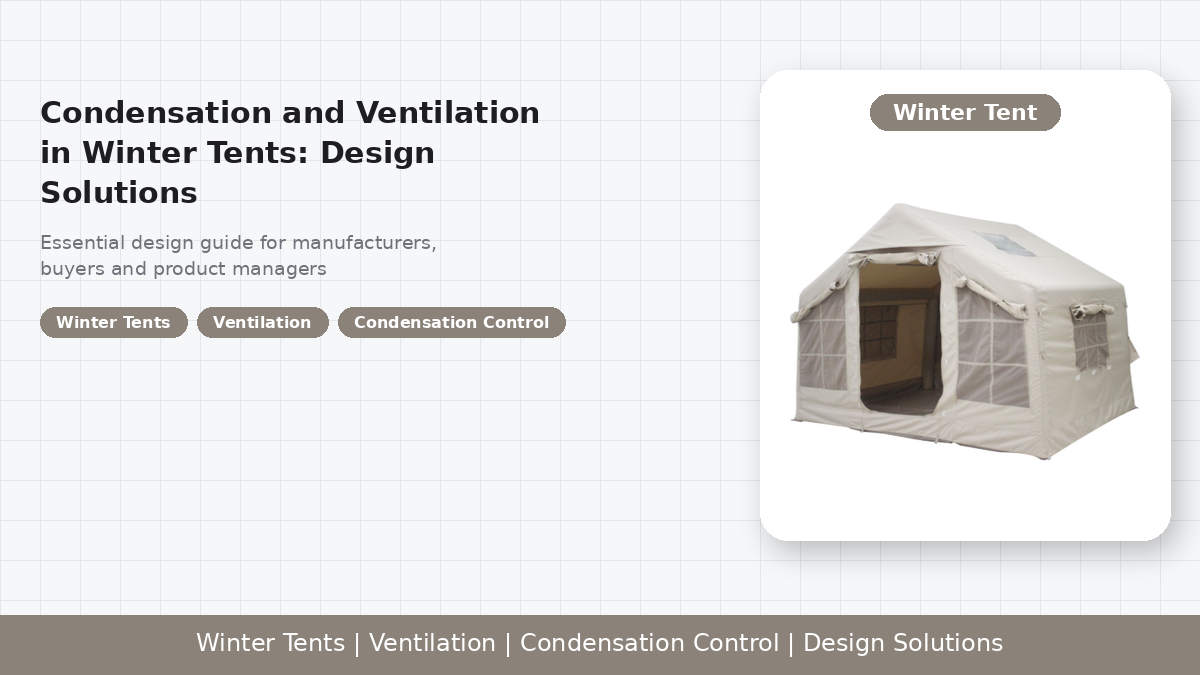
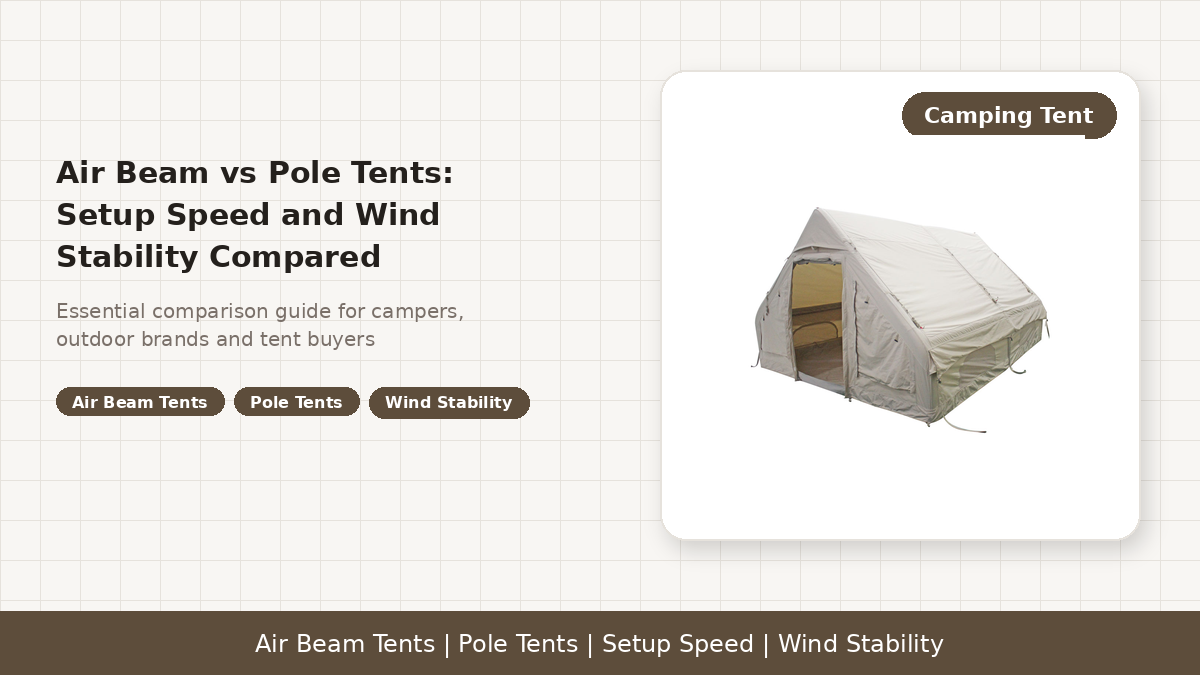
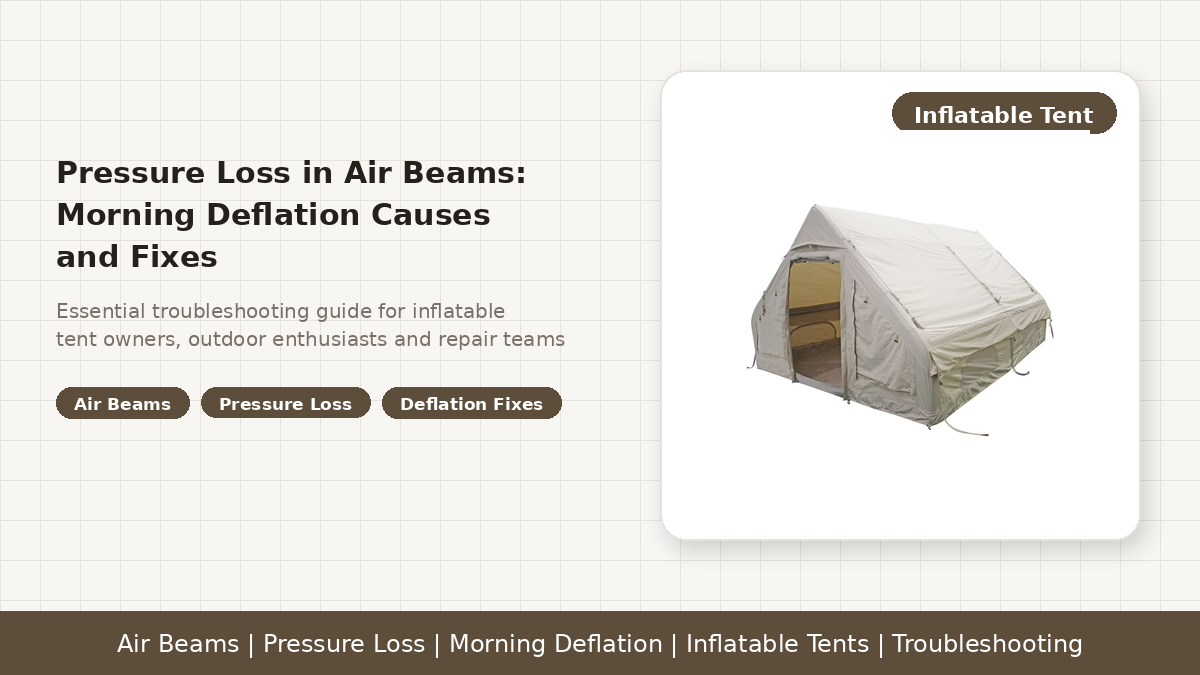
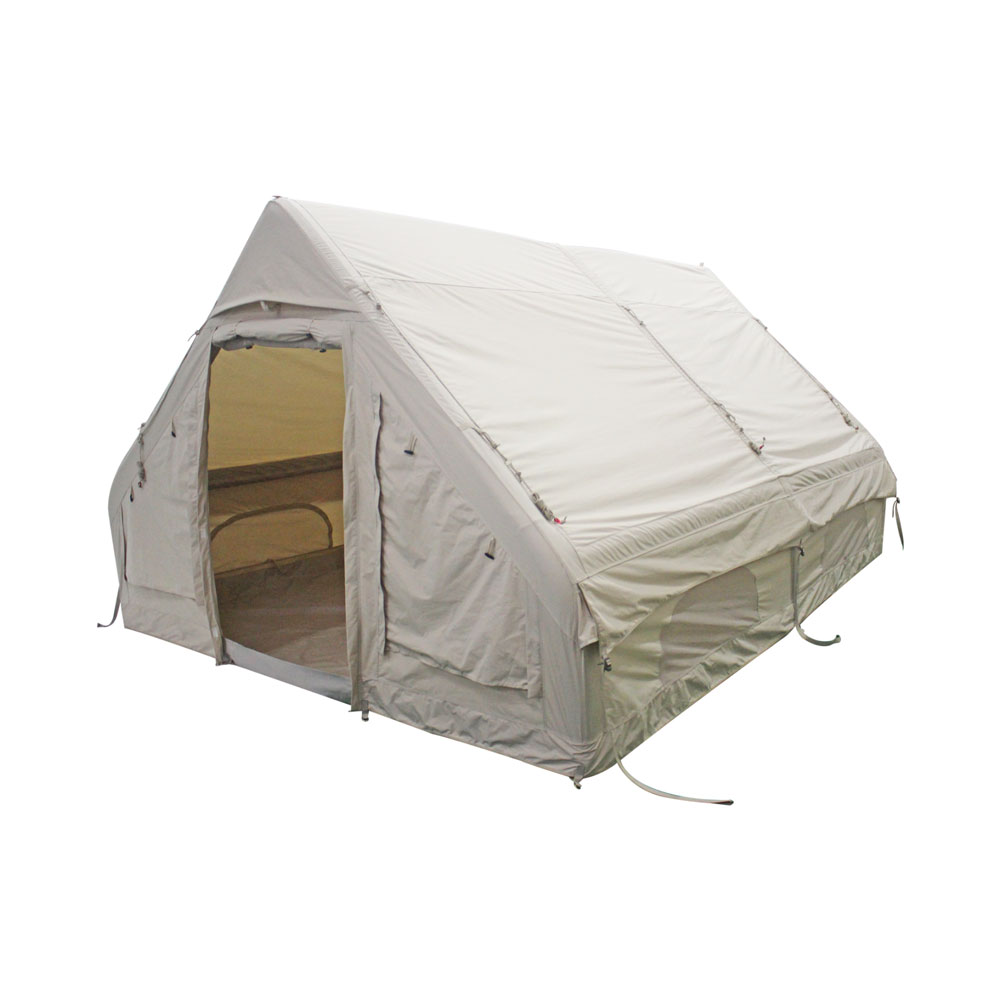
- Our inflatable tent with pump uses a one-piece PVC air frame inflated by the supplied hand pump, with no poles and no complicated assembly, built in 210D Oxford fabric with SBS zippers, two symmetrical double-zipper doors and six dual-layer mesh windows.
- Choose by wind exposure and cycle count, not by the setup-time claim, because the setup advantage only pays for itself where the tent is pitched repeatedly.
An air beam tent takes minutes to pitch, and a pole tent takes substantially longer, because the air beam removes the assembly step rather than making it faster. Our inflatable tent with pump instant glamping camping tents uses a one-piece PVC air frame that inflates with the included hand pump — no poles, no complicated assembly. In an exposed site, however, an air beam is generally the weaker structure in wind, because it holds its shape through internal pressure while a pole tent holds its shape through a member in tension.
Both results come from the same mechanism, and once you can name it the comparison stops being a contest. An air beam is a pressurised shell. Its stiffness is a function of internal pressure, seam geometry and how much of the surface is in tension against that pressure. A pole tent is a frame. Its stiffness is a function of member diameter, material and the geometry of the frame itself. Because pressure responds to what happens around it and a frame does not, the two constructions behave differently the moment conditions stop being ideal.
The practical consequence is that an air beam resists wind by being anchored down rather than by shedding load, and that changes the anchoring requirement rather than removing it. Because our inflatable tent range includes a disaster relief variant built with a bright orange PU-coated Oxford outer cover and a dark gray PU polyester inner lining, both rated CPAI-84 Level 5 flame retardant and resistant to temperatures as low as -30 °C, the range is specified across quite different duties — and the duty, not the construction, decides where each one belongs.
Why Does the Air Beam Pitch Faster Than a Pole Tent?
An air beam pitches faster because it deletes the assembly step rather than making the same step faster. A pole tent is assembled: poles are threaded, corners are located, the fly is pulled over the frame, and the whole thing is tensioned until it holds its shape. Because every one of those operations is a step that can be done out of order or done twice, the pole tent has a long sequence in which a single mistake has to be undone before the next step can begin.
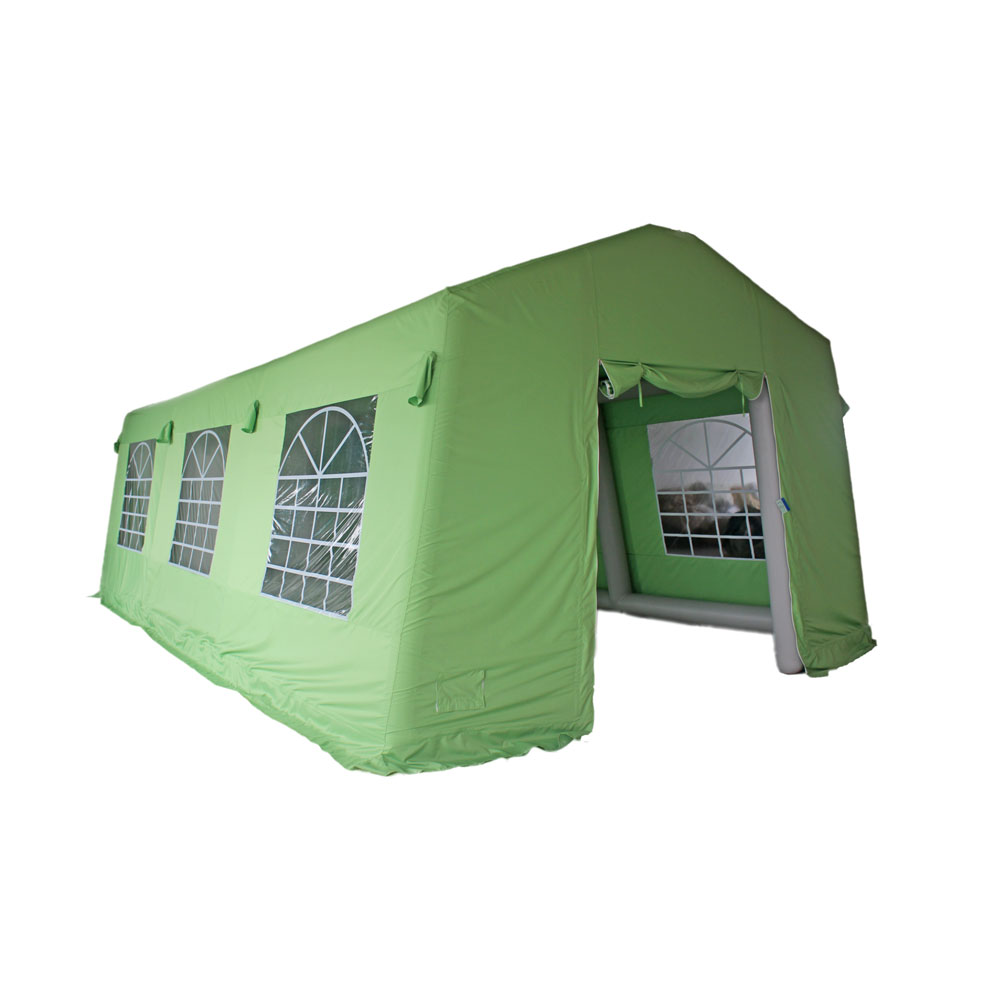
An air beam replaces that sequence with one operation: pressure. Because the air frame is one piece and the structure is defined once the air is in it, the only remaining decisions are where it goes and how it is held down.Our emergency Inflatable Tent is published as fully set up in just a few minutes using the integrated PVC air frame and the included manual pump, with no tools required, and it is specifically described as a one-piece design that lets rescue teams deploy multiple tents quickly.
Let me put the honest limit on that claim, because marketing has overcooked it. "Sets up in minutes" is measured on a calm day, on level ground, by people who have done it before, with the tent already laid out at the site. Because the air beam has no assembly sequence, it has no assembly errors either — but it does have a packing-out step, and on a wet or windy site that step is where the time actually goes. I would rather a buyer hears that from me than discovers it on a launch site.
Why Is an Air Beam Weaker in Wind Than a Pole Tent?
An air beam is generally weaker in wind because a pressurised shell responds to load in a way a frame does not. A pole tent carries wind load through its members into the ground. The load path is fixed at design time. An air beam carries the same load through tension in its fabric skin, and that tension is set by how much air is inside it and how tightly the seams are sealed.
Because the two structures reach equilibrium differently, they also fail differently. A pole frame that is overloaded will typically deform in a way that redistributes load, while an under-inflated air beam presents a shape that catches wind rather than one that sheds it. That is why an air beam that has lost pressure overnight is not a tent that is slightly softer — it is a sail.
The failure I would actually worry about is the quiet one. An air beam does not leak loudly. It loses pressure slowly, and the structure looks perfectly fine standing up — slightly softer, slightly more rounded, entirely usable. Because nothing about its appearance says anything is wrong, the loss is usually detected when the tent is struck, weeks later, or when it collapses in the wind. A pressure check at the start of every pitch is the cheapest insurance in this entire article, and it is the step almost nobody performs.
Which Five Variables Decide the Comparison?
Five variables decide the comparison, and setup time is the one buyers start from and should finish with. All five can be settled before a sample is ordered.
| Variable | What it decides | Failure when ignored |
|---|---|---|
| 1. Wind exposure of the site | Whether exposed terrain is possible, which overrides the setup advantage entirely. | An air beam pitched on an exposed site and left through a gale, because the site was assumed sheltered on the day of the pitch. |
| 2. Setup cycles per season | Whether the setup advantage is worth anything, since it only pays for itself where the tent is pitched repeatedly. | An air beam bought for its pitch speed and then pitched twice a year, where the advantage never appears. |
| 3. Anchoring plan | Whether the tent is held down properly, which is how an air beam resists wind at all. | A structure that is not anchored as specified, because the anchor type was chosen after the tent rather than with it. |
| 4. Packing volume | Transport and storage cost, which changes the calculation for a distributor holding stock. | Storage cost calculated on erected volume for a product that actually deflates to a fraction of it. |
| 5. Acceptance of partial states | Whether the operation can tolerate a pitch that was interrupted partway. | An interrupted pitch abandoned, because an air beam that is half inflated is not half standing. |
How Does the Anchor Plan Change With the Construction?
The anchor plan changes fundamentally with the construction, and this is the point most often left until the tent has already been chosen. A pole tent resists wind by being held down through its frame and its guy lines, which pull outward against the ground anchors. An air beam resists wind the same way but has no frame to pull against, so the anchoring is what supplies the reaction force, and it has to be specified rather than assumed.
Because the inflated structure presents a large sail area to any wind, the number and type of anchors is not a detail for an air beam in the way it is for a frame. Because an air beam has no guy-out points in the sense a pole tent has, the anchor plan and the tent type have to be chosen together rather than separately, and choosing them separately is how a perfectly good air beam ends up badly anchored on an exposed pitch.
Here is where I disagree with how this is usually marketed. Air beam tents are frequently presented as being as wind-capable as pole tents because the marketing copy talks about fabric strength and the fabric is, in our case, 210D Oxford with durable SBS zippers. Because fabric strength and structure stiffness are different properties, a strong fabric in a structure with no stiffness behind it is not a wind-resistant tent. Any comparison that quotes fabric denier as evidence of wind performance is quoting the wrong number.
What Does Partially Inflated Actually Mean?
A partially inflated air beam produces nothing usable, and that is a genuine operational difference rather than an inconvenience. A pole tent caught halfway through assembly is a pole tent that can be finished later, sometimes by a different person, sometimes the next day. An air beam caught halfway through inflation is a bag of fabric with a shape in it.
Because the structure has no usable intermediate state, an operation that assumes partial progress is possible will get stuck. Because inflation is fast, this matters less than it sounds — but it matters enormously at the moment when the weather turns or the daylight goes, which is exactly the moment when being able to leave and come back is what you need.
For rescue and relief work, which is where our disaster relief inflatable tent sits, the trade runs the other way. Because there is no assembly sequence to interrupt, a team can deploy tents one after another without one person holding a partially built structure while another waits, and our published description puts it precisely this way — a one-piece design that allows rescue teams to deploy multiple tents quickly.
What Does Packing Volume Change for a Distributor?
Packing volume changes the storage and freight calculation more than most buyers model it, because the comparison is usually made against a pole tent's erected size rather than its packed size. A pole tent packs down to a bag roughly the volume of its fabric. An air beam packs down to approximately the volume of its fabric as well, because that is what it is made of. On paper they are similar.
Because they are similar on paper, the real difference appears in a different place: handling and labour at both ends of the logistics chain. An air beam arrives as a soft bag with a pump, so unpacking, positioning and pitching replace unpacking, unpacking, positioning and pitching. That is a genuine operational saving, and it is invisible if you only compare the packed dimensions.
Let me be straight about the other side of that trade, because it is where returns come from. A pump is a mechanical item that can be lost, broken or forgotten, and our Inflatable Tents ship with a carrying bag and a pump for exactly that reason. Because a missing pump turns a tent that is otherwise fine into a tent that cannot be used, I would treat pump supply as part of the product rather than as an accessory, and I would push back on any quote that prices it as an option.
Which Construction Should You Choose?
Choose an air beam when the tent will be pitched frequently, when the site is sheltered, and when the people pitching it are not experienced.That combination is why Inflatable Tents have grown so quickly in the glamping and leisure rental market, and it is not a fad.
Choose a pole tent when the site is exposed, when the tent will stand unattended for long periods, or when the pitch will be interrupted and resumed. Choose both when you run a range, because they serve genuinely different customers and a distributor carrying only one leaves half the market unserved.
Choose air beam for high-frequency leisure use
Choose air beam for high-frequency leisure use, festival ground, glamping sites and hire businesses where the tent is struck and re-erected constantly and the pitch is often done by customers rather than staff. Because the setup advantage only pays for itself where cycles are high, a low-frequency application cannot justify the construction on speed grounds alone.
Choose pole tent for exposed and unattended sites
Choose pole tent for exposed terrain, long-standing pitches and any site where a gale is a realistic event rather than a theoretical one. Because an air beam resists wind by being held down rather than by shedding load, an exposed site needs an anchoring capability that a sheltered site does not demand. Where a tent will stand through a season without being checked, the structure that shows visible deformation under load is the safer one.
Choose air beam where temperature extremes matter
Choose air beam where temperature extremes matter and the tent is used in cold conditions, because our disaster relief variant is published as resistant to temperatures as low as -30 °C with a CPAI-84 Level 5 flame retardant construction on both the outer cover and the inner lining. Because the two fabric layers serve different purposes — weather barrier outside, comfort and separation inside — that specification is not interchangeable with a single-layer leisure tent.
Choose pole tent when partial progress matters
Choose pole tent when partial progress matters, which in practice means pitches that get interrupted and resumed. Because an air beam has no usable intermediate state, an interrupted pitch produces nothing, and for some operations that is disqualifying regardless of how fast the completed pitch would have been.
How to Choose Between Air Beam and Pole Tent in Five Steps
Five steps settle it, and the first one is deliberately the one that most often decides the answer on its own.
- Establish the wind exposure the site will see. Determine whether the tent will be pitched somewhere a gale is possible. Because an air beam resists wind by being anchored rather than by shedding load, an exposed site favours a pole tent regardless of how convenient the air beam is to pitch.
- Count the setup cycles per season. Because the air beam's advantage is the removal of the assembly step, that advantage only pays for itself where the number of cycles is high enough to matter.
- Confirm the anchoring plan before choosing the structure. An inflatable structure has no guy-out points in the sense a pole tent has, so the anchor plan and the tent type have to be decided together rather than sequentially.
- Check the fabric specification against the exposure. Our inflatable family tent uses 210D Oxford with SBS zippers, and our disaster relief variant uses PU-coated Oxford with a PU polyester inner lining rated CPAI-84 Level 5, so the two are not specified for the same duty.
- Decide whether partial states are acceptable to your operation. Because an air beam has no partial assembly, an interrupted pitch produces nothing usable, whereas an interrupted pole tent pitch can usually be finished later.
Building a tent range and not sure which way to split it?
If you are deciding where to place an air beam and where to place a pole tent, send us your duty profile — wind exposure, cycle count, temperature range and whether pitches get interrupted. We will tell you which construction fits each application, and we will say so plainly when a duty points outside what we build.
Send us your duty profile or review the inflatable tent range directly.
Frequently Asked Questions
Are air beam tents as wind resistant as pole tents?
Generally no, and the reason is structural rather than material. A pole tent carries wind load through its members into the ground, and that load path is fixed at design time. An air beam carries the same load through tension in its fabric skin, where the tension is set by internal pressure and seam geometry. Because an under-inflated air beam presents a shape that catches wind rather than one that sheds it, and because fabric strength is a different property from structure stiffness, quoting a denier figure as evidence of wind performance is quoting the wrong number.
How long does it actually take to pitch an air beam tent?
Our emergency Inflatable Tent is published as fully set up in just a few minutes using the integrated PVC air frame and the included manual pump, with no tools required. Because the structure has no assembly sequence, it also has no assembly errors. However, the published figure is measured on calm days, on level ground, by experienced users, with the tent already laid out at the site, and on a wet or windy pitch the packing-out and positioning steps are where the time actually goes.
Why does my inflatable tent go slack overnight?
Because it is losing pressure, and an air beam does not leak loudly — it deflates slowly, and the structure still looks usable standing up, just slightly softer and more rounded. Nothing about its appearance indicates a problem, so the loss is usually noticed when the tent is struck weeks later or when it collapses in wind. A pressure check at the start of every pitch is the cheapest safeguard, and checking seams, valves and the airtight edging is where you should start.
Do inflatable tents need different anchoring than pole tents?
Yes, and this should be decided before the tent is chosen rather than after. A pole tent resists wind through its frame and guy lines, which pull outward against ground anchors. An air beam has no frame to pull against, so the anchoring supplies the reaction force, and an inflated structure presents a large sail area to any wind. Because an air beam has no guy-out points in the sense a pole tent has, the anchor plan and the tent type have to be chosen together.
Can an air beam tent be partially assembled and left overnight?
Not in any useful sense. A pole tent caught halfway through assembly can usually be finished later, sometimes by someone else, sometimes the next day. An air beam caught halfway through inflation is a bag of fabric with a shape in it, because the structure has no usable intermediate state. Because inflation itself is fast, this matters mainly when the weather turns or daylight fades, which is exactly when being able to leave and return is valuable.
Are inflatable tents suitable for cold weather camping?
They can be, provided the specification matches the temperature. Our disaster relief Inflatable Tent is published with a bright orange PU-coated Oxford outer cover and a dark gray PU polyester inner lining, both rated CPAI-84 Level 5 flame retardant, and resistant to temperatures as low as -30 degrees Celsius. That is a different specification from our leisure family tent, so the two should not be treated as interchangeable across temperature ranges.
What fabric should an inflatable tent be made from?
Our inflatable family tent uses high-density 210D Oxford fabric with durable SBS zippers, a house-like design with two symmetrical double-zipper doors and six dual-layer mesh windows, and it ships with a carrying bag and a pump. The disaster relief variant uses a PU-coated Oxford outer with a PU polyester inner lining. Because the outer fabric and the inner lining serve different purposes — weather barrier outside, comfort and separation inside — a single-layer specification should not be read as equivalent.
Do inflatable tents pack smaller than pole tents?
The packed volumes are actually similar, because in both cases the packed size is essentially the volume of the fabric. The real difference appears elsewhere: handling and labour at both ends of the logistics chain. An air beam arrives as a soft bag with a pump, so unpacking, positioning and pitching replace the same three steps on a pole tent. Because that saving is invisible if you compare only the packed dimensions, it is usually missing from the business case.
What is the strongest argument against choosing an air beam tent?
The absence of a usable intermediate state combined with the dependence on maintaining pressure. Because the structure exists only while it is inflated, any interruption to the pitch or any pressure loss produces a structure that cannot be used, and because the loss is usually invisible until strike or collapse, it is rarely caught early. For any operation that depends on leaving a site and returning to it, that combination is disqualifying regardless of how fast the completed pitch would be.