




Every tent standing in bad weather is standing on its anchors, and most anchoring failures are decided long before the wind arrives. Sand will not hold a stake, snow changes both the load and the ground, and a deck is not a site but somebody’s structure. Here is how each surface resists pull-out, and what belongs in the specification.
TL;DR
- Anchoring is the end of the load path: on a 3×3 m gazebo a 28 m/s gust produces roughly 4,320 N across 12 load paths, so one peak joint can carry over 600 N.
- Sand fails by pull-out, so embedment depth and guy count matter more than stake diameter, and a heavier frame never fixes a weak anchor.
- Snow adds vertical load and a snow surface that acts as a sail, and it changes the ground too, because frozen soil grips until the thaw.
- A deck is a finite structure, so the anchor has to land in a joist or an engineered plate, and penetration usually costs more than ballast.
- Specify the anchor package as part of the structure, with the load demand, fixing detail and surface condition written down.
An anchoring package is not a bag of accessories, it is the last load path in the structure, and the only part in contact with something the manufacturer does not control. Because the anchor transfers wind load into soil, sand, snow or a deck joist, and each behaves differently under pull-out, the surface decides the anchor.
The frame work on our side has already quantified what reaches the ground. In QIAHE’s own published cyclic wind loading analysis, a 28 m/s gust on a 3×3 m commercial gazebo produces approximately 4,320 N across 12 primary load paths, with peak joints sustaining over 600 N. Because the anchor reacts those loads continuously while the frame is cycled hundreds of times per season, an anchor specified by habit is the cheapest route to an insurance claim.
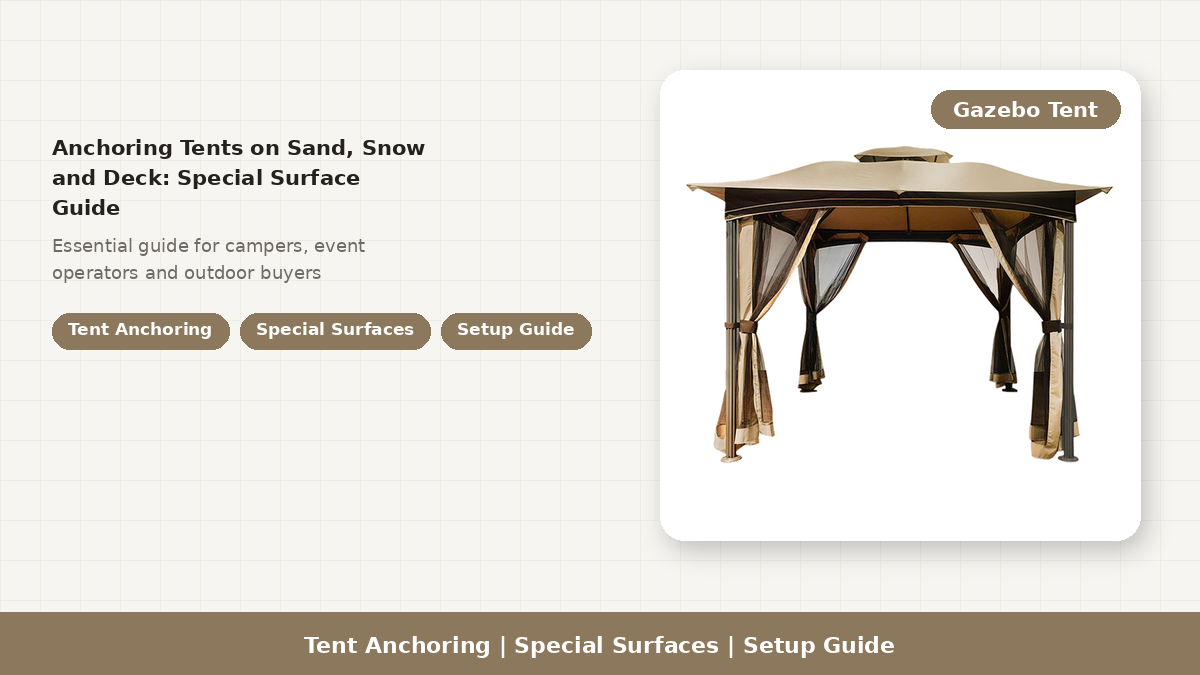
Our cyclic wind loading failure analysis for pop-up canopy frame joints sets out where the load comes from, our folding gazebo range is the structure most anchoring questions arrive with, and the contact page is where a site-specific anchoring specification gets written.
Anchoring is where the load path ends
An anchor does not reduce load, it transfers it, and the transfer is where most tent failures happen. The published analysis on our site of cyclic wind loading failure in pop-up canopy frame joints quantifies that load for a 3×3 m commercial gazebo: the dynamic pressure term q = 0.5 ρ v² at a 28 m/s gust produces approximately 4,320 N of total force, it reaches the ground through 12 primary load paths, and peak joints often sustain over 600 N in a typical 8-hour event.
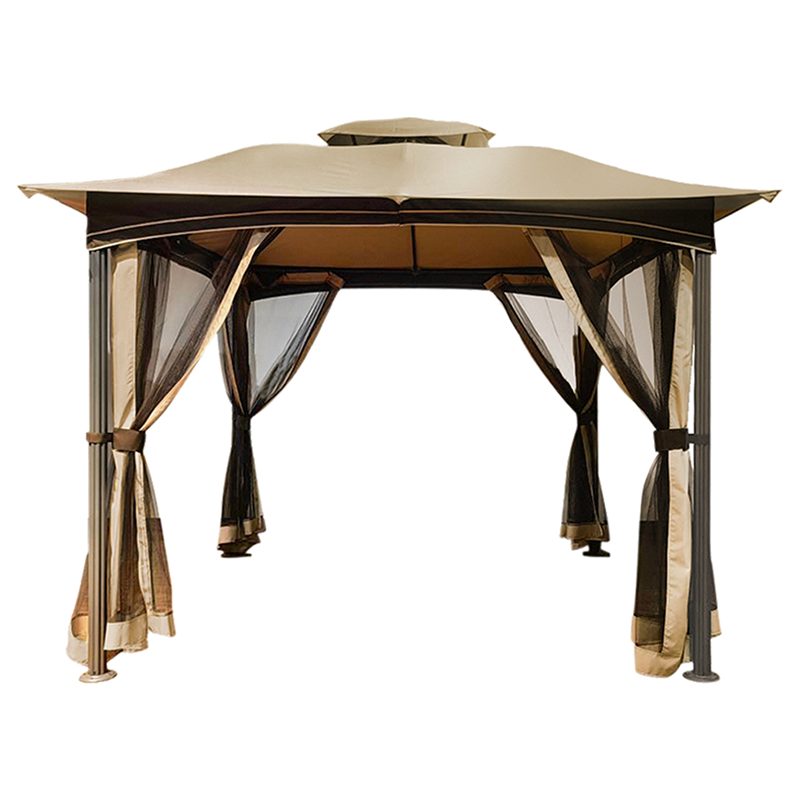
The frame lowers the demand before the anchor sees it, which is why the frame data belongs in the anchoring document. The same analysis shows a triangulated truss of 8 triangles and 6 diagonals carrying 40 % of the bending moment, dropping joint stress from 56 MPa to 34 MPa and improving fatigue life by 300 %, from 107 to 3×10⁷ cycles. Because the anchor is usually the weakest element in the assembly, a heavier frame does not rescue a weak anchor, it only makes the failure later, with more stored energy.
| Load path element | Typical force | What the anchor resists |
|---|---|---|
| Peak joint, 4 per gazebo | Over 600 N, cyclically | Tension per anchor, thousands of cycles |
| Corner leg, 8 per gazebo | Vertical load plus a moment | Shear and uplift at the foot |
| Whole structure at 28 m/s | About 4,320 N total | The reaction that must stay on site |
| Guy line | Tension only | Line anchorage, pull-out |
| Ballast, where used | Dead weight plus friction | Surface friction, not soil |
Sand: the surface with no holding power
Dry sand has no cohesion, so a stake resists pull-out with nothing more than its own weight and the friction of the sand cone around it, and that cone is what you are buying. Embedment depth and guy count therefore matter more than stake diameter, and sand backfills, so a stake loose enough to walk out of is loose enough for the first gust. Because the pull-out force arrives at the leg as a moment, the wider the stance and the more load carried by guys, the less the anchor holds alone.
What we specify for sand is a system rather than a peg, because the failure mode is the system. A guy line tied to a buried anchor moves tension out of the frame joints and into the ground. Because the same gazebo cannot ship with one accessory list for a beach and a park lawn, the specification belongs to the tent and the site together.
| Option | How it resists pull-out | Where it fails |
|---|---|---|
| Stake with guy lines | Embedment plus friction cone, guys carry tension | Low-density sand, poor embedment |
| Weighted leg or sand anchor | Footprint and dead weight add mass | Needs level ground, heavy to move |
| Ballast plates on the feet | Plate friction plus dead weight | Must be tied down, plates catch wind |
| Stake and plate combined | Friction cone plus footprint | Hard-packed sand, plate cannot seat |
Snow: vertical load, a sail of snow, and a ground that lies
Snow changes three things at once: it adds vertical load to the roof, turns the roof into a sail that catches the wind, and changes the ground under the anchors while they carry that load. The vertical load arrives through the same joints that already carry cyclic wind load. The sail effect is underestimated, because a smooth snow layer on a pitched roof behaves like a wing and adds uplift to the load the anchoring was sized for in summer.
The most expensive snow mistake is trusting the ground on the day you install, because frozen sand and frozen soil hold far better than they will after a thaw. Because ground resistance is seasonal rather than permanent, a snowy-site specification has to be written for the weakest state of the ground, which means deeper embedment, more anchors per leg and guying that limits how far the structure can move before load reaches the anchors.
| Condition | Added load path | How it is handled |
|---|---|---|
| Snow accumulation on the roof | Vertical load through the wind load joints | Roof pitch that sheds snow, or clearing after a storm |
| Snow surface acting as a sail | Uplift added on top of the wind load | More guys, tighter anchor spacing |
| Freeze and thaw cycle | Ground resistance rises while frozen, falls after | Specify for the weakest state, deeper embedment |
| Ice dams at the eave | Lateral push on the leg line | Roof clearance, heat or manual removal |
Deck: you are drilling into somebody else’s structure
A deck is not a site, it is a structure with a limited load path, and that difference decides the whole approach. Deck boards are thin and span between joists, so a screw driven into a board carries almost no uplift while the same screw in a joist carries it properly. The deck belongs to somebody else and will be inspected by somebody else, so the specification has to protect the tent in the wind and the deck it is drilled into, and the second is harder to guarantee.
On a deck, penetration is often the wrong answer and ballast is frequently the better one.Our Folding Gazebo range uses a central lock system for one-person setup in minutes and adjustable legs with three height settings, so a unit can be levelled and ballasted without drilling. Where permanent fixing is wanted, it goes into a joist or an engineered base plate through a sealing layer with the owner’s written agreement, because an anchor that pulls water into a deck is a different problem from one that fails in a field.
| Method | Fixing point | Damage risk | Verdict |
|---|---|---|---|
| Ballast on the feet | Deck surface only | None, if it cannot slide | Preferred on rented decks |
| Structural screws into the joist | Joist, through the board | Low when sealed | Correct for permanent installs |
| Lag bolts into the joist | Joist, with a plate | Splitting and water ingress | Acceptable with owner approval |
| Deck screws into the board only | Board, not the joist | Board pull-out in uplift | Do not use for uplift |
| Engineered base plate or through-bolt | Joist or ledger | None with a plate, consent needed | Best permanent detail |
How to specify an anchoring package for a buyer
Five steps, and the first one decides whether the rest are meaningful.
- Get the surface declared in writing. For sand, the ground state and how it will be prepared; for snow, the design condition and weakest seasonal state; for a deck, the board and joist construction and the owner’s written approval for penetration.
- Get the load demand from the frame, not from the accessory list. The peak joint force, the number of load paths and the guy geometry, published by the tent supplier.
- Match the anchor type to the surface and state the detail. Embedment depth, plate size, fixing into joist or plate, and the anchor material, because a galvanised stake and an aluminium frame need a separation detail.
- State the number, spacing and tension of the guys, and who checks them. A guy line that is fitted but slack is the same as no guy line, so the check belongs in the setup procedure.
- Ship the anchor package as a bill of materials per unit. Quantities per leg and per guy line, the ballast ratio, and a re-tension procedure after a storm.
Four anchoring mistakes and where QIAHE fits
Four mistakes account for most anchoring claims, and none is exotic: anchoring by accessory list rather than by load demand, one stake per leg on sand, under-guying on snow, and drilling a deck without the owner’s written approval or a sealing layer. Every one is a documentation failure rather than a hardware failure.
Which is why none of it works as a bolt-on, and why it has to be engineered at the frame.Ningbo Qiahe Products Co., Ltd. was founded in 2002 in Yuyao City, Zhejiang Province, and has more than two decades of manufacturing and export experience across carports, gazebos, folding tents, Inflatable Tents, awnings, parasols, swings and greenhouse structures.Because the frame is machined from 6061-T6 aluminium with CNC connectors, hard anodizing of 25 µm Type III at 400 HV and 3-rib reinforcement at 120° spacing tested to ASTM B117, the anchoring demand can be written against a frame that publishes its own fatigue data.
Frequently asked questions about tent anchoring on sand, snow and decks
What is the best way to anchor a tent on sand?
There is no single best method, because sand has no cohesion and the anchor resists pull-out with its own weight and the friction cone around it. What works is a system: real embedment depth, a pinned or weighted leg, and guy lines carrying tension into the ground. The load is substantial, with approximately 4,320 N at a 28 m/s gust across 12 load paths and over 600 N at a peak joint, so a stake per leg is rarely enough.
Do I need more stakes than legs on a gazebo?
On sand and on snow, yes, because the legs are vertical elements with almost no holding power on their own, while the guys are tension members that do the real work. Every guy line needs its own anchor in prepared ground, because a stake driven into unprepared beach sand will pull out.
Can I put a gazebo on a wooden deck?
Yes, and on a deck, ballast is usually better, because a deck is somebody else’s structure and drilling into it creates damage inspected long after the tent is gone. Where the unit stays, the fixing goes into a joist or an engineered base plate with a sealing layer and the owner’s written agreement.
Which anchors work in snow?
The ones sized for the weakest state of the ground, not the frozen state on installation day. Snow adds vertical load to the joints that carry the wind load, turns the roof into a sail that increases uplift, and freeze-thaw means an anchor that grips on day one can be loose after a thaw, so deeper embedment and tighter guying are the answer.
Does the tent warranty cover anchoring?
A frame warranty covers the frame, not the ground, the deck or the way the unit was installed, so the anchoring specification has to be documented separately in the handover pack. A buyer should be able to produce the load demand, the anchor type and embedment, the guy layout and the surface condition after a wind event, and without them the claim is hard to defend.
Where to start
If you are specifying tents for a site where the surface is not firm level ground, the fastest route is to tell us the surface, the unit and the worst condition you expect, and let the anchoring package be written with the structure. Because an anchoring package is cheap to specify before the order and expensive to fix after a claim, the fastest first step is a site conversation with the surface details in hand.
Request an anchoring specification
Send the surface, the gazebo or tent model, the intended season and the destination market, and we return the load demand, the anchor and guy layout and the handover document set.
Published 28 October 2026 · Last verified 28 October 2026 · Load path figures, joint forces, fatigue life and hardware specifications verified against the published QIAHE cyclic wind loading failure analysis; frame construction and adjustable leg options verified against the published QIAHE Folding Gazebo page; founding year, location and product range verified against the published QIAHE about page. The anchoring commentary in Tables 1 to 4 is engineering interpretation for surface selection, not a site-specific anchorage calculation, which has to be produced for the actual soil, snow and deck condition. References:ASCE 7 loads on structures, JRC Eurocode 1 actions on structures, ASTM B117 salt spray practice. No price, cost or margin figure is quoted in this article.