




Awning Fabric Replacement Cycles: What Retail Chains Should Budget
If you manage awning replacements across 50, 200, or 2,000 storefronts, the question I hear most from procurement teams is not "which fabric lasts longest." It is "how do I budget for fabric replacement without either over-spending on early swaps or getting burned by surprise failures." After 20 years of OEM awning programs with retailers across the EU, Australia, the Gulf, and Latin America, I have learned that the right answer is a rolling plan, not a one-time bulk purchase.
This guide is written for the retail-chain procurement manager who has to defend a multi-year fabric-replacement budget to finance. I will walk you through the eight drivers that determine replacement cycle, the five-year rolling budget framework I recommend, the four end-of-life signals that should override the calendar, and the questions to put on every fabric quote. For the technical side of fabric failure modes, see our photo-oxidative degradation engineering article; this one stays at the procurement level.
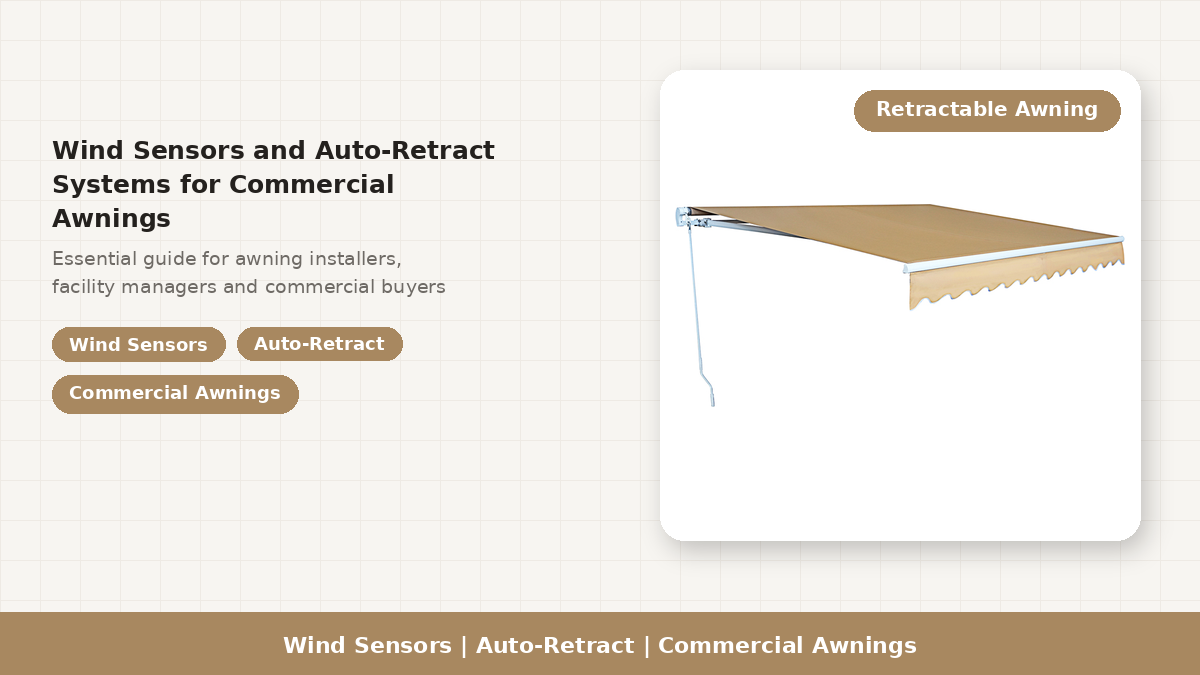
If you want to see the catalog side first, our awning product category shows the range of fixed, retractable, and leg-tube formats we ship under OEM/ODM programs.
1. Typical Awning Fabric Life Span by Material
Before you can plan a replacement cycle, you need a starting number. Most polyester and Acrylic Awning Fabrics last 5-8 years under normal residential or light commercial use. PVC-coated polyester typically reaches 8-12 years because the coating carries most of the UV load. Commercial and coastal environments shorten lifespan to 4-6 years for uncoated fabrics, because salt and high UV work together to break down the surface faster than UV alone. These are typical ranges I see across our programs, not warranties — your real replacement timing depends on climate, UV dose, and maintenance.
| Fabric type | Temperate inland | High-UV inland | Coastal |
|---|---|---|---|
| Polyester (solution-dyed) | 6-8 | 5-7 | 4-6 |
| Acrylic (woven) | 7-9 | 5-7 | 4-5 |
| PVC-coated polyester | 10-12 | 8-10 | 7-9 |
| Polypropylene (lightweight) | 4-6 | 3-5 | 2-4 |
I personally avoid quoting these numbers in writing to a procurement manager without the climate column attached, because the temperate-inland figure looks generous until you realize the same fabric will fail 2-3 years earlier at a beachside store. The range itself is honest, but using only the high end for budget purposes is not.
2. The Five Drivers That Move the Replacement Date
Five drivers will shorten or extend the fabric life versus the typical range. I track them in this order because the first two dominate the second two in nearly every portfolio I have reviewed.
UV exposure. The single largest driver. A unit that sees 8 hours of direct sun per day fails materially faster than one that sees 4 hours. South-facing and west-facing facades lose roughly 20-30% more color than north-facing over the same period.
Climate zone. Coastal salt accelerates coating breakdown; high-UV inland regions (Mediterranean, Gulf, Australia, southern US) accelerate polymer degradation. I treat these two zones as "fast-cycle" by default.
Fabric weight. Heavier fabrics (300-600 gsm) typically outlast lighter fabrics (180-250 gsm) by 2-4 years under the same exposure, because thicker yarn resists UV penetration deeper into the weave. However, weight alone does not guarantee durability; the UV stabilizer package and coating chemistry matter more than grams per square meter.
Maintenance frequency. A unit cleaned every 6-12 months with pH-neutral soap typically lasts 1-2 years longer than the same unit left unmaintained, because organic deposits trap moisture against the coating.
Operating hours per day. A retractable awning used 6 hours per day in summer will not last as long as one used 2 hours per day. I have seen this single factor shift replacement intervals by 18-24 months within identical stores, and I now ask retail buyers to estimate operating hours before I quote a fabric for them.
3. The Four End-of-Life Signals That Should Override the Calendar
A calendar-based replacement plan only works if you let real-world condition override the calendar. Four end-of-life signals tell you to act now, regardless of where the unit sits in your rolling plan.
- Visible fading from the street. Color loss above roughly 15-20% versus the original sample is the most reliable early-warning signal. I check from across the parking lot before I check on the ladder.
- Brittleness or cracking when folded. If the fabric cracks audibly or shows white stress lines when retracted for the season, the polymer has lost molecular weight and a winter wind event can tear it.
- Water no longer beading on the surface. The hydrophobic topcoat has worn through. Once water soaks into the weave, cleaning cannot reverse the damage and replacement typically follows within 6-12 months.
- Seam separation or fabric stretching. Stitching failure or visible sag means the unit cannot retract properly. Letting it run risks motor damage, which converts a fabric-replacement job into a frame-and-motor replacement job.
I have personally overruled a calendar and pulled a fabric at year 4 because of signal 2, and the customer thanked me six months later when a storm would have torn it off the frame. A good rolling plan has room for these overrides; a rigid plan does not.
4. The Five-Year Rolling Budget Framework
The framework I recommend to retail-chain procurement teams has four components: an inventory, a climate grouping, a replacement calendar, and a contingency reserve. I have walked customers through versions of this for stores ranging from 40 units to 2,000 units, and the framework scales without losing accuracy.
Step 1 — Inventory every store. Build a spreadsheet with one row per store: install date, fabric type, frame model, climate zone, and last inspection note. I provide a template to OEM customers during onboarding, but any spreadsheet works as long as the columns are consistent.
Step 2 — Group stores by climate exposure. Classify each store as coastal, high-UV inland, or temperate. Coastal and high-UV stores cycle 1-2 years faster than temperate stores, and a single bulk calendar will mis-budget both ends.
Step 3 — Build a rolling calendar. Replace 15-20% of the portfolio each year rather than bulk-refreshing every fifth year. This spreads cash flow, avoids concentrating the maintenance workload on a single season, and prevents the "all stores fail the same year" trap.
Step 4 — Keep a 10-15% contingency reserve. Some stores will fail earlier than the calendar predicts. I have never seen a portfolio hit the exact replacement date on every unit. The reserve prevents firefighting when one or two stores need emergency replacement outside the rolling plan.
| Year | Stores replaced | Profile | Notes |
|---|---|---|---|
| 1 | 30 (15%) | Coastal + oldest units | Pair with frame inspection |
| 2 | 35 (17.5%) | High-UV inland | Standard fabric SKU |
| 3 | 40 (20%) | Mixed | Standard fabric SKU |
| 4 | 45 (22.5%) | High-UV + temperate older units | Pair with motor service |
| 5 | 50 (25%) | Mixed end-of-cycle | Reserve release year |
I built the percentages above to accelerate replacement in the first two years so the portfolio is mostly aligned by year 3. After year 5, the cycle repeats with the new install cohort, and the calendar becomes self-correcting. I find that procurement teams who try this for one cycle never go back to bulk replacement.
5. How to Compare Awning Fabric Quotes
Most fabric quotes fail the procurement test because they leave out the information a portfolio manager needs. Compare on five dimensions, not just unit price. I walk through each one with new OEM customers before we sign the first frame PO.
- Base fabric weight (gsm). Heavier is generally longer-lasting, but not always. I require the gsm to be on every quote.
- UV stabilizer chemistry and rating. Look for ISO 105-B02 xenon-arc ratings or equivalent. A rating of 6-7 is the practical minimum for outdoor; 7-8 is preferred for high-UV zones.
- Coating type and thickness. Acrylic-coated, PVC-coated, or PU-coated — each behaves differently in salt spray and UV. State the coating thickness in microns.
- Seam construction. Single-needle, double-needle, or welded. For coastal and high-UV programs I require welded or double-needle with UV-stable thread.
- Warranty terms in writing. Specifically the pro-rated replacement schedule, the climate-zone exclusions, and the inspection cadence the warranty requires.
I have personally walked away from a quote that was 12-15% cheaper than the next one because the UV rating was missing, and the customer came back 18 months later on the original spec. A quote that omits any of these five items is incomplete, regardless of the unit price.
6. Pair Fabric Replacement With Frame Inspection
The single biggest cost saver in a multi-store replacement program is to lift the unit only once. If you are already paying for the technician to be on site for a fabric swap, have them inspect the frame, the mounting brackets, the motor (on retractable units), and the pitch adjustment at the same time. Doing both at once typically halves the per-unit service cost compared with separate fabric and frame visits, and it cuts the disruption to the storefront in half.
I personally insist on this when I am working with retail buyers, because I have seen too many programs where the fabric is replaced on schedule and the frame fails two years later because nobody was on the ladder to look at it. A small inspection at fabric replacement catches corrosion at the bracket, motor-bearing wear, and pitch drift before they become safety issues.
7. OEM Replacement Fabric vs Aftermarket Fabric
For multi-store portfolios, OEM replacement fabric almost always out-performs aftermarket fabric on lifecycle variance. OEM fabric is cut to the original frame dimensions, includes factory-applied UV-stabilizer coating matched to the fabric chemistry, and is backed by a documented warranty with the same terms across the chain. Aftermarket fabric is often a generic textile resold to fit common frame sizes; UV performance and warranty coverage vary widely.
The case for OEM is strongest in two situations: when the portfolio has more than 50 stores, and when the stores are spread across multiple climate zones. The case for aftermarket is when the frame is an obsolete model no longer supported by the original factory, and OEM fabric is no longer available — in which case the choice is aftermarket or full frame replacement. I help buyers run this comparison when they reach out to us through our quote and sample request page.
8. Maintenance Actions That Extend Fabric Life
Three maintenance actions extend life materially. I have included them here because they cost almost nothing per store and they directly affect the budget line you are trying to defend.
- Retract in sustained winds above roughly 25-30 km/h. Wind vibration is the largest mechanical wear factor on the fabric and the stitching. A simple wind-sensor switch pays for itself inside two seasons.
- Clean with pH-neutral soap every 6-12 months. Remove leaves, bird droppings, and dust. These organic deposits hold moisture against the coating and accelerate breakdown.
- Inspect seams and stitching annually. A small re-stitch in year 3 prevents a full seam rebuild in year 6. Annual inspection is the single most cost-effective maintenance action for a fabric portfolio.
I personally walk store managers through this list during onboarding, because the difference between a portfolio that hits its 7-year average and one that hits its 5-year average is almost entirely these three actions.
How to Plan Awning Fabric Replacement for a Multi-Store Portfolio
- Inventory every store's awning age and fabric type — build a spreadsheet with one row per store: install date, fabric type, frame model, climate zone, and last inspection note. This becomes the planning baseline for the next five years.
- Group stores by climate exposure — classify stores as coastal, high-UV inland, or temperate. Coastal and high-UV stores cycle 1-2 years faster than temperate stores.
- Build a rolling replacement calendar — replace 15-20% of the portfolio each year rather than bulk-refreshing every fifth year. This spreads cash flow and avoids lifting all frames in the same maintenance window.
- Standardize fabric specs across the chain — pick one or two fabric SKUs from a single OEM and apply across the chain. This reduces variance, simplifies warranty handling, and shortens lead time.
- Pair fabric replacement with frame inspection — lift the unit once per fabric replacement to inspect the frame, motor, and mounting hardware. Doing both at once halves the per-unit service cost.
- Keep a 10-15% contingency reserve — some stores will fail earlier than the calendar predicts. A reserve prevents firefighting when one or two stores need emergency replacement outside the rolling plan.
- Log post-replacement feedback per store — capture the actual condition at removal (fading, brittleness, seam failure mode) and feed this back into the next calendar cycle. Empirical replacement data beats vendor estimates over time.
Frequently Asked Questions
How long does a typical awning fabric last before it needs replacement?
Most polyester and Acrylic Awning Fabrics last 5-8 years under normal residential or light commercial use. PVC-coated polyester typically reaches 8-12 years. Commercial and coastal environments shorten lifespan to 4-6 years for uncoated fabrics. These are typical ranges, not warranties; actual replacement timing depends on climate, UV exposure, and maintenance.
What signs tell a retail chain it is time to replace awning fabric?
The four end-of-life signals are: 1) fading visible from the street (color loss above roughly 15-20% versus original), 2) brittleness or cracking when the fabric is folded, 3) water no longer beading on the surface (hydrophobic coating worn off), and 4) seam separation or fabric stretching that prevents proper retraction.
How should a retail chain budget for awning fabric replacement across a multi-store portfolio?
Plan on a rolling 5-year replacement cycle rather than a single bulk event. Replace 15-20% of the portfolio each year, prioritizing coastal and high-UV stores first. Pair the fabric replacement with frame inspection so you only lift the unit once. Keep a 10-15% buffer for stores that fail earlier than expected.
Does fabric weight affect replacement cycle?
Yes. Heavier fabrics (300-600 gsm) typically outlast lighter fabrics (180-250 gsm) by 2-4 years under the same exposure, because thicker yarn resists UV penetration deeper into the weave. However, weight alone does not guarantee durability; the UV stabilizer package and coating chemistry matter more than grams per square meter.
Can retail chains extend awning fabric life without replacing it sooner?
Three maintenance actions extend life materially: 1) retract the awning during sustained winds above roughly 25-30 km/h, 2) clean with pH-neutral soap every 6-12 months to remove organic deposits that hold moisture, and 3) inspect seams and stitching annually so small failures are repaired before water ingress damages the core fabric.
What is the difference between OEM replacement fabric and aftermarket fabric?
OEM replacement fabric is cut to the original frame dimensions, includes factory-applied UV-stabilizer coating matched to the fabric chemistry, and is backed by a documented warranty. Aftermarket fabric is often a generic textile resold to fit common frame sizes; UV performance and warranty coverage vary widely. For multi-store portfolios, OEM fabric reduces the variance in replacement intervals.
How do you compare awning fabric quotes from different manufacturers?
Compare on five dimensions, not just unit price: 1) base fabric weight (gsm), 2) UV stabilizer chemistry and rating (for example, UV-resistant per ISO 105-B02), 3) coating type and thickness, 4) seam construction (single-needle, double-needle, welded), and 5) warranty terms in writing. A quote that omits any of these five items is incomplete.
If you want a copy of our retail-chain replacement-planning template — including the climate-zone grouping spreadsheet, the five-dimension fabric quote scorecard, and the rolling-replacement calendar I described above — send a note through our contact page and I will route it to the right regional manager. I review every retail-chain inquiry personally, so you will hear back from a person, not a chatbot.