




Carport Anchoring on Asphalt and Gravel: What Installers Recommend
TL;DR
- Asphalt: through-bolt or adhesive anchors for permanent installs; expansion anchors work for light-duty but lose holding power in heat above 25-30 degrees Celsius.
- Gravel: deep earth anchors driven 450-600mm minimum into compacted subsoil -?shallow stakes grip only loose aggregate and will pull out under wind load.
- The ground beneath the surface matters more than the surface itself. Probe gravel before anchoring; check asphalt substrate before choosing an anchor type.
- Through-bolt anchors into a concrete footer deliver the highest pull-out resistance on asphalt but require surface penetration not feasible on all sites.
- Re-torque expansion anchors 30 days after first loading. Inspect seasonally and before extreme weather events. These two steps prevent most anchoring failures.
The Question Most Buyers Skip Until the First Storm
When buyers evaluate carports, they spend most of their time on the fabric weight, the steel tube gauge, the wind rating, and the powder-coating finish. Anchoring is an afterthought -?the line item that gets value-engineered to the cheapest stake or bolt, and the first thing that fails when a genuine wind event hits the structure.
In 20 years of outdoor event and carport installations, I have seen anchoring failures range from a collapsed tent at a garden wedding to a carport frame twisted beyond repair after a single overnight storm. The root cause in every case traced back to one of three errors: an anchor type chosen for convenience rather than substrate compatibility, a surface installed without understanding the subsurface, or a seasonal inspection that was skipped.
The two most common ground surfaces for carport installations are asphalt and gravel. Each has a fundamentally different set of anchor physics, failure modes, and maintenance requirements. The wrong choice is not discoverable until something breaks. This guide is the field reference I give every client before they sign off on installation.
For a full technical breakdown of why wind loading is the primary stress that anchoring must resist -?and how cyclic wind forces progressively damage frame joints and anchor connections the cyclic wind loading failure analysis on our technical resource page walks through the engineering basis. Anchoring is the physical solution to the forces described in that article.
The Anchor-to-Ground Physics You Need to Understand First
The carport frame applies three types of force to its anchor points: uplift(wind lifting the Canopy vertically),lateral shear (wind pushing the frame sideways), and tension (combined uplift plus diagonal frame loading). Failure to account for any one of these three is the root cause of the majority of anchoring-related structural failures I have investigated in the field.
The substrate -?the material the anchor grips into -?determines how much resistance is available. On an asphalt parking lot, the anchor actually grips the asphalt and transfers load into whatever is beneath it. On a gravel driveway, the anchor must pass through the loose gravel into the compacted formation below, or it is gripping nothing that will hold under load.
The critical concept is effective embedment depth. An anchor driven 50mm into loose gravel grips material that can be shovelled by hand. An anchor driven 500mm through that same gravel into the clay beneath transfers load to a formation with genuinely different mechanical properties. Depth alone is not the whole answer, but it is the most commonly neglected variable in gravel-surface anchoring.
Anchoring on Asphalt: Methods, Risks, and What Actually Holds
Asphalt is a flexible pavement -?a mixture of aggregates bound together with bitumen. It behaves as a semi-rigid surface with viscoelastic properties: it softens in heat, cracks in cold, and yields under sustained loading. Each characteristic affects which anchors work and which fail.
Through-Bolt Anchors -?The Gold Standard
Where structural conditions allow it, a through-bolt anchor -?where a high-tensile bolt passes completely through the asphalt layer and is fixed into a concrete footer or the native subgrade -?delivers the highest pull-out resistance of any common anchor type. The asphalt provides a bearing surface; the concrete below provides the actual holding formation. Through-bolt anchors are the only anchor solution where the asphalt surface itself is not the primary load-bearing element.
The limitation is obvious: through-bolt installation requires drilling or pre-placing full-depth holes through the asphalt. On a private driveway or car park where you control the installation, this is straightforward. On a rented event space, shared parking structure, or any surface where penetrating the pavement is prohibited, through-bolts are not an option.
Adhesive (Chemical) Anchors
Adhesive anchors use a two-component resin system injected into a drilled hole, which bonds the anchor rod to the hole wall in the asphalt substrate. The holding mechanism is chemical adhesion rather than mechanical interference, which gives two significant advantages:
- Lower sensitivity to asphalt softening in heat -?adhesive anchors do not rely on friction against the asphalt wall, making them more consistent across the full summer temperature range.
- Minimal splitting stress -?no radial expansion forces are applied to the hole wall during installation or loading, which is important in thinner asphalt sections where expansion anchors can cause cracking.
A contaminated hole will cause adhesive bond failure -?this is the most common installation error with chemical anchors, and it is completely preventable with standard cleaning procedure. Adhesive anchors require a clean, dry hole: any dust, moisture, or oil contamination will reduce bond strength significantly. They also require a cure time before loading, which makes them unsuitable for same-day event setup.
Expansion Anchors -?Acceptable With Caveats
Expansion anchors work by driving a threaded bolt into a cylindrical sleeve inserted in a drilled hole, forcing the sleeve walls outward against the hole wall. The friction between the sleeve and the asphalt provides the holding resistance. Expansion anchors lose holding power as asphalt temperature rises -?in direct sun, an expansion anchor can lose 20-30% of its rated holding power by early afternoon on a hot summer day.
Expansion anchors are appropriate only for temporary event use, moderate climates, or low wind-rated carports. They are not appropriate for permanent sun-exposed asphalt installations, or anywhere the anchor load approaches the rated capacity.
Asphalt Temperature and Anchor Selection: The Decision Matrix
Based on the physics described above, the practical anchor selection for asphalt follows a temperature and load matrix:
- Surface temperature below 20 degrees Celsius, low-to-moderate wind load: Expansion anchors are acceptable. Test pull-out resistance at installation.
- Surface temperature above 25 degrees Celsius or moderate-to-high wind load: Adhesive anchors are the minimum spec. Through-bolts into a subgrade footer are preferred.
- Permanent installation, any temperature range: Through-bolt or adhesive anchor. For any year-round outdoor installation on asphalt, specify adhesive or through-bolt anchors -?the marginal cost difference is minimal compared to the cost of a structural failure.
The EN 13782 standard for temporary structures specifies that anchor design must account for temperature variation in the range of -10 degrees to +40 degrees Celsius at the installation site, with material strength values adjusted accordingly -?the engineering basis for the conservative temperature recommendations in this guide. The OSHA guidance on temporary work structure safety further specifies that anchor systems for temporary structures must be capable of withstanding maximum anticipated environmental load with a safety factor of not less than 2:1.
Anchoring on Gravel: Methods, Risks, and What Actually Holds
Gravel surfaces are deceptively challenging. The loose aggregate layer looks like a solid surface, but it has essentially no shear strength until you reach the compacted formation beneath. Anchors driven only into the loose layer behave as if screwed into a pile of large sand -?the material has no cohesive strength to resist pull-out force transferred through the anchor shaft.
Earth (Screw or Arrowhead) Anchors
Earth anchors -?screw anchors or driven arrowhead anchors -?are the primary solution for gravel surfaces. The critical specification is embedment depth: the anchor must pass through the loose gravel layer and engage with the compacted soil or clay beneath. For a typical 100-150mm gravel layer over compacted subgrade, this means a minimum embedment of 400-500mm measured from the finished surface.
Screw anchors are screwed into the ground with a drive rod or auger tool. Arrowhead anchors are driven vertically and then seated at an angle by pulling the cable attached to the anchor head. Both work on the same principle: the anchor element at the end of the shaft is larger than the shaft itself, so load transfers to the soil below the loose layer rather than pulling the shaft through the gravel.
If the anchor continues to screw in with minimal torque resistance, it has not reached competent material -?proceed deeper until torque increases sharply. A torque of 40-60 Nm on a 12-16mm diameter shaft is a reasonable field indicator of adequate engagement in typical clay subsoil conditions.
Deadweight Ballasting
Where anchoring into the subsurface is not possible -?for example, on a gravel surface over bedrock, or where subsurface utilities prevent deep driving -?deadweight ballasting provides an alternative. The carport feet are weighted with concrete blocks, water tanks, or steel plates to resist uplift through gravity alone.
Deadweight ballasting alone cannot anchor a standard carport frame in wind speeds above approximately 80 km/h equivalent -?the uplift force per corner exceeds what practical ballast mass can counter in most configurations. Ballasting is most useful as a supplement to earth anchors: adding 50-80kg of ballast per corner to a carport already secured with earth anchors significantly improves the system wind rating without requiring additional anchor points.
The Subsurface Investigation: Why You Should Dig Before You Anchor
The most common professional-grade mistake on gravel surfaces is anchoring without understanding what is below the gravel. A 150mm layer of gravel over compacted clay is a dramatically different anchor substrate than 300mm of gravel over soft, silty sand. The surface looks identical.
Before specifying anchor type or estimating pull-out resistance, check the subsurface. Drive a thin steel rod or soil probe through the gravel by hand to measure the depth to competent resistance. A hand-probe and visual assessment of the extracted material takes 10 minutes per anchor point and is sufficient to classify the subsurface for most carport installations. The ISO 22475-1 geotechnical investigation standard covers the full methodology for those who want a formal classification. If the probe meets minimal resistance at less than 200mm from the surface, the gravel is sitting over a soft or loose subsoil -?earth anchors driven to standard depths may not find adequate grip.
Asphalt vs. Gravel: The Direct Comparison
| Factor | Asphalt Surface | Gravel Surface |
|---|---|---|
| Typical substrate profile | Rigid bituminous layer, 40-100mm thick, over concrete or compacted aggregate base | Loose aggregate, 50-300mm thick, over compacted natural soil (clay, sand, or mixed) |
| Best anchor types | Through-bolt (preferred), adhesive (recommended), expansion (acceptable with caveats) | Earth anchors (screw or arrowhead, min 400-500mm embedment), supplemented with deadweight ballasting |
| Primary failure mode | Expansion anchor migration in heat; adhesive bond failure if surface prep is inadequate | Anchor pulling through loose surface layer; upward migration due to freeze-thaw or moisture cycles |
| Temperature sensitivity | High -?asphalt softens above 25-30 degrees C; expansion anchor performance degrades measurably | Low for the anchor mechanism itself; but freeze-thaw cycles in subsurface can disrupt anchor engagement seasonally |
| Seasonal maintenance requirement | Re-torque expansion anchors 30 days after loading; inspect for surface cracking annually | Check embedment depth each spring and after major weather events; re-drive or replace migrated anchors |
| Surface penetration required | Yes -?at minimum into the asphalt; ideally through to concrete sub-base | Yes -?must pass through loose layer into competent subsoil below |
| Best for permanent install | Through-bolt or adhesive anchor into concrete footer | Deep earth anchor (screw, 500mm+ embedment) with supplemental ballast |
| Best for temporary/event use | Expansion anchor with load calculation confirming adequate margin above anticipated wind load | Arrowhead earth anchor with drive-tool installation; re-check torque after first 24 hours |
The Wind Loading Connection: Why Anchoring and Frame Engineering Are One System
It is tempting to treat anchoring as a separate engineering question from the carport frame itself. The frame has its wind rating; the anchor has its pull-out resistance. The cyclic wind loading failure analysisdescribes why this approach fails: wind forces on a Carport Canopy are not static. They pulse. The frame-to-anchor connection is the point where cyclic loading concentrates, and where the interaction between frame stiffness and ground resistance determines whether the system survives repeated wind events or progressively works loose over time.
Anchoring that is adequate for a single extreme wind event may fail under repeated cycles of moderate wind loading because each loading-unloading cycle works the anchor slightly loose. This is why professional event rental companies treat anchor inspection as a non-negotiable part of every setup procedure. The EN 13782 standard defines anchor design requirements including fatigue loading for repeated-use installations -?if your supplier's engineering data does not specify a pull-out force per anchor point tested under defined substrate conditions, ask for it before purchase.
Seasonal Maintenance: The Inspections That Prevent Catastrophic Failure
Every anchoring system degrades over time. The rate depends on the substrate, the climate, and the loading history. The inspections below are the minimum professional-grade maintenance schedule I recommend to every commercial carport operator.
After First Installation -?Day 30 Check
Expansion anchors settle under cyclic loading. The single most effective seasonal maintenance action for asphalt expansion anchors is re-torque at 30 days -?this compensates for embedment settlement and prevents the majority of late-season failures. Re-torque all expansion anchors to the manufacturer-specified torque value at day 30. Any anchor that cannot be re-torqued to specification has lost effective grip and must be replaced before the structure is loaded again.
Seasonal Checkpoints and Pre-Weather Events
At the start of each season, inspect all anchor points for signs of movement: surface cracking on asphalt, water pooling at anchor bases, or visible uplift of gravel around stakes. Pull-test a sample of anchors (one per corner, minimum) to verify holding force has not degraded. On gravel, measure the exposed shaft length above the surface -?any increase since installation indicates upward migration and reduced embedment.
Pre-event anchor inspection takes 10-15 minutes per carport and prevents the majority of anchoring-related failures in storm conditions. Any forecast wind event above the carport's rated wind speed should trigger this check immediately, not as an afterthought the morning after the storm has passed.
The Decision Framework I Actually Use With Clients
When a client tells me they need to install a carport on asphalt or gravel, here is the decision tree I walk them through in the first conversation:
Step 1 -?Surface type: Asphalt requires drilling; gravel requires driving. Asphalt is a rigid substrate with temperature-dependent holding capacity; gravel requires depth engagement below the loose layer into competent subsoil.
Step 2 -?Ownership of the surface: Own it, or operating on a temporary-use site? Through-bolts require surface penetration and are off the table on rented or shared pavement.
Step 3 -?Wind rating of the carport: Match anchor spec to the frame's rated wind load. An anchor with inadequate pull-out resistance anchoring a high wind-rated frame is a mismatched system regardless of how strong each component is individually.
Step 4 -?Subsurface investigation: For gravel, probe to determine the depth to competent subsoil. For asphalt, confirm the substrate below the pavement. The substrate below the surface is what actually holds the anchor -?not the surface itself.
Step 5 -?Seasonal use pattern: Year-round permanent installations require higher-spec anchors and documented inspection schedules. Seasonal strike-and-restore use allows lighter anchors but demands rigorous re-inspection at each setup.
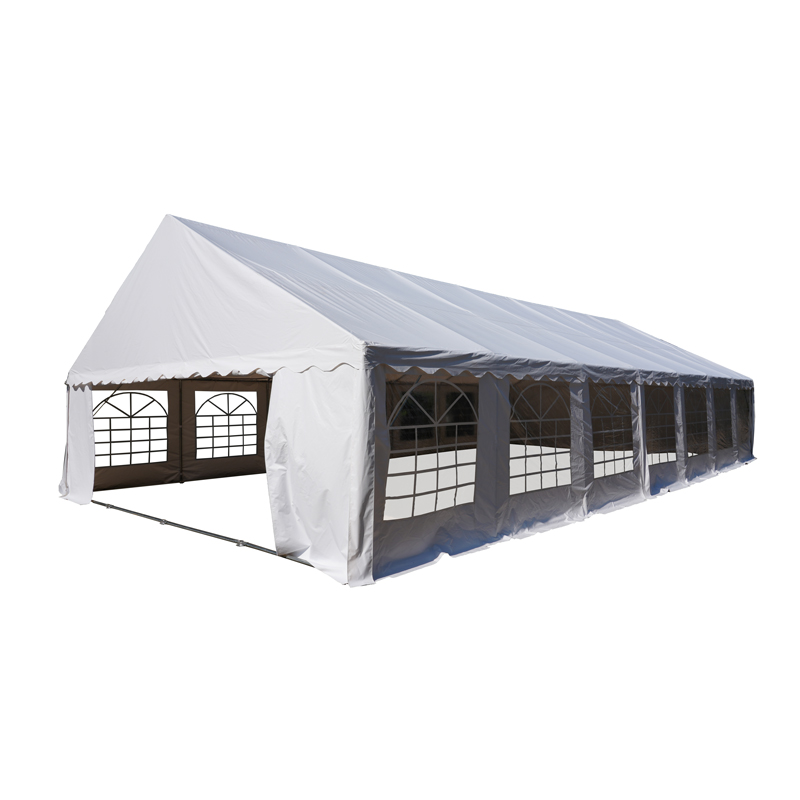
If you are evaluating a heavy-duty PVC outdoor event and storage canopy carport and want a specific anchor recommendation for your site conditions, the QIAHE technical team can provide anchor specifications matched to your installation surface and local wind load data.
Frequently Asked Questions
What is the best anchor for a carport on asphalt?
A through-bolt anchor -?passing completely through the asphalt into a concrete footer below -?delivers the highest pull-out resistance. Where through-bolting is impractical, a high-strength adhesive (chemical) anchor gives the best alternative holding power on asphalt. Expansion anchors are acceptable for light-duty or temporary use but lose friction-based holding power as asphalt softens in heat above 25-30 degrees Celsius.
How do you anchor a carport on loose gravel?
Gravel surfaces require deep earth anchors (screw or arrowhead) driven through the loose aggregate layer into the compacted subsoil below. Screw anchors must reach at least 450-600mm below the finished surface -?anything shallower grips only loose aggregate and will pull out under even moderate wind loading. Supplemental deadweight ballasting improves performance but cannot replace proper depth engagement.
Do asphalt anchors work differently in hot weather?
Yes. Asphalt is a viscoelastic material that softens measurably above 25-30 degrees Celsius. Expansion anchors lose friction-based holding power as the asphalt softens, often losing 20-30% of rated capacity in direct summer sun. Adhesive (chemical) anchors are less temperature-sensitive because they bond chemically to the substrate rather than relying on mechanical friction against the hole wall.
How often should carport anchors be checked?
Inspect anchors at the change of each season and before any forecast extreme weather event. Re-torque expansion anchors 30 days after first loading -?this single step prevents the majority of late-season asphalt anchor failures. On gravel, measure exposed shaft length at each inspection: any increase since installation signals upward migration and reduced embedment that requires re-driving or replacement.
Can a carport be anchored on both asphalt and gravel in the same installation?
Yes, and this is common in event venues with mixed surfaces or carports spanning a driveway (asphalt) and gravel shoulder. Specify different anchor types for each surface condition and verify even load distribution across all corners. A carport with one corner on a proper asphalt anchor and the opposite corner on a shallow gravel stake will develop torsional stress that no anchor system can fully compensate for.
Final Note From the Field
Anchoring is not the exciting part of a carport specification. But it is the system that determines whether the structure survives its first season or its first storm. Getting it right is not expensive -?it requires only matching the anchor type to the substrate, installing to the correct depth or torque, and inspecting seasonally. Those three steps eliminate the large majority of anchoring-related field failures I have seen in 20 years of this business.
If you are evaluating options for a commercial carport deployment and want to discuss site conditions and anchor specification, reach out to the QIAHE team before finalizing your purchase. Anchoring is a specification decision that should be made before you sign, not after delivery.