




If you are specifying shade for a hotel pool deck, you are choosing between two products that solve the same problem from opposite directions. Here is how I walk buyers through that decision on real projects, and why the right answer is usually not either-or.
TL;DR — The 60-Second Version
- Cantilever Umbrellas win on layout flexibility and repositioning the shade as the sun moves across the deck.A single cantilever covers roughly 8 to 20 m² with no central pole under the Canopy.
- Fixed awnings win on permanent coverage of a known footprint, year-round weather protection, and continuous runs along a facade. Each unit covers roughly 5 to 24 m² depending on projection and width.
- Wind rating, not fabric weight, is the single most important specificationon any commercial Cantilever Umbrella data sheet.
- Fixed awnings attached to a building usually require a permit and engineering documentation; Cantilever Umbrellas typically do not.
- Most hotel pool projects combine both — a fixed awning along the guest perimeter and Cantilever Umbrellas over the open pool surface.
Direct answer. Because hotel pool decks are not flat rectangles and the sun is not stationary,a Cantilever Umbrella and a fixed awning are not competing solutions. They solve different parts of the same brief. In my work at QIAHE, I walk every hotel buyer through the same question first:where does the building end and where does the deck begin?The answer decides which product goes where, and most of the projects I support end up using both. The fixed awning covers the bar, the dining perimeter, and the transition between the building and the deck. The Cantilever Umbrella covers the open pool surface where the sun moves and the wind gusts. I have watched this question resolve a procurement argument that had been running for weeks, because it shifts the conversation from “which product” to “where on the deck.”
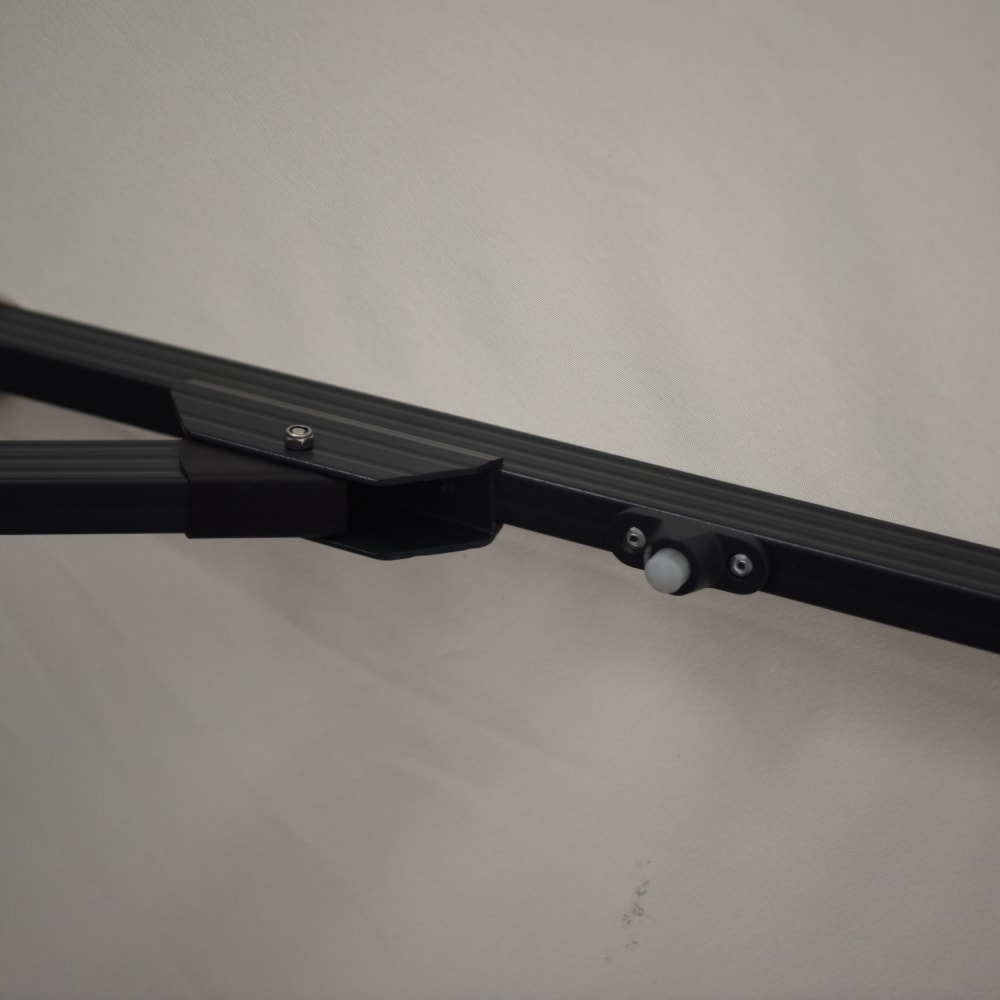
Commercial Cantilever Umbrella with aluminum pole, 8 ribs, and polyester PA-coated cover. Frame performance referenced againstASTM E330 for structural loading and ASCE 7 for wind load calculation on North American sites. Source: QIAHE Sun-Protective LED Outdoor Umbrella.
What a Cantilever Umbrella Actually Is on a Hotel Pool Deck
A Cantilever Umbrella has its pole mounted to one side of the canopy instead of through the center, which frees the shaded footprint from a vertical obstruction. Because there is no center pole, the deck under the canopy stays open for loungers, side tables, and guest circulation, which is why this geometry dominates the high-end pool market. The trade-off is structural: the offset pole has to carry the bending load of the entire canopy, so the base, the ribs, and the pole material have to be engineered as one system. I usually walk buyers through this geometry on the first call, because the moment they see the offset pole, the layout decisions downstream start to make sense.
At QIAHE, our commercial cantilever umbrella uses an aluminum pole at 109×72×2.5 mm, eight aluminum ribs at 35×22×2.0 mm, and a 250 g polyester cover with PA coating. Because the cover weight, the rib length, and the pole section are specified together, the umbrella can carry a single airvent at the top for wind relief and still hold shape under typical wind load. I usually walk buyers through those four numbers on the first call, because they tell me most of what I need to know about whether the umbrella is engineered for commercial use or for a residential backyard.
Where Cantilever Umbrellas Win on a Pool Deck
- The deck is irregular. Pool decks almost never run in straight lines, and an L-shaped or kidney-shaped deck is hard to cover with a fixed awning. A cantilever umbrella can be placed at each anchor point and rotated to follow the geometry. I have used three umbrellas to cover a curved infinity edge where a single awning would have missed half the loungers.
- The shade needs to follow the sun. Cantilever umbrellas rotate 360 degrees on most commercial bases, and many of our units tilt as well. Because the umbrella tracks the sun, the same shaded footprint can cover morning sunbeds, midday loungers, and the bar seating at sunset without the property buying extra umbrellas.
- The property wants a repositionable solution. Hotel operators reconfigure pool decks seasonally. A cantilever umbrella on a wheeled or bolt-down base can be moved, which a fixed awning cannot.
- No building permit is required. Most jurisdictions treat commercial cantilever umbrellas as movable furniture rather than building fixtures. Because no permit is required, installation is faster, paperwork is lighter, and the property can refresh the layout without re-engaging the building authority.
- Branded fabric panels are part of the visual identity. A cantilever umbrella takes printed valances and canopy panels cleanly, which makes the property's logo and color story visible from across the deck. I usually recommend that hotel buyers source a swatch set before the production order, because the printed panel on a small swatch does not always match the visual impression on a full canopy.
Where Cantilever Umbrellas Hit Their Limits
- High wind exposure. A cantilever umbrella is a sail when it is open. Because the canopy presents a large surface area to the wind, every commercial umbrella must be closed and secured above the rated wind speed, which is typically 30 to 50 km/h steady. Properties on coastal or hilltop sites need to plan for daily closing cycles.
- Continuous shade over a long run. Five umbrellas in a row never look as clean as one fixed awning that spans the same wall, and the gaps between umbrellas let the sun in at the wrong hour.
- Heavy snow or storm seasons. Umbrellas must be closed and stored before severe weather. Because the umbrella cannot stay deployed in a storm, the property needs a written closing protocol and somewhere to store the canopy when not in use. I have watched properties lose umbrellas to a single overnight storm because no one on the night shift checked the weather app, so I now insist on the closing protocol before delivery.
What a Fixed Awning Actually Is on a Hotel Pool Deck
A fixed awning is a permanent shade structure attached to the building envelope, typically with an aluminum or steel frame and a coated fabric or metal cover. Because the awning is anchored to the building, it does not need a separate base, it can project further than a freestanding umbrella, and it stays deployed through conditions a cantilever umbrella would not survive. The trade-off is permanence: the awning is part of the building, and changes to its position are a construction project. I always tell buyers to think of the awning the same way they think of a balcony — it is part of the architecture, not part of the furniture, and it has to be specified to the same performance envelope.
At QIAHE, our fixed-awning line includes three configurations: a manual garden sunshade awning for light commercial use, an aluminum awning with leg tube support for medium-span commercial projects, and a manual and electric aluminum awning for projects that need both options or full automation. The standard fabric is 280 g PU-coated polyester, which is heavier and more weatherproof than the 250 g PA-coated polyester used on most of our umbrellas. Because the fabric weight is higher, the awning handles UV, wind, and rain better, but it also costs more per square meter and takes longer to replace. We align the fabric and frame specification with EN 13561 for performance requirements of external blinds and awnings, which is the standard our European hotel buyers usually reference.
Where Fixed Awnings Win on a Pool Deck
- Continuous coverage along a facade. A fixed awning can run the full length of a wall in one piece, with no gaps between units. Because the awning spans the wall, guests walking from the bar to the loungers stay in continuous shade, which is exactly what the operator wants on a hot afternoon.
- Year-round weather protection. A fixed awning stays deployed through more weather than an umbrella. Because the awning is permanently anchored, it handles coastal gusts, summer storms, and shoulder-season rain without daily closing cycles.
- Larger graphic surfaces for branding. A fixed awning presents a single large fabric panel that takes high-resolution prints cleanly. Properties that want a signature visual element above the deck use the awning as the canvas.
- Permanent integration with lighting and audio. Fixed awnings can be specified with integrated LED strips, speakers, and even radiant heaters, which the property cannot retrofit onto a cantilever umbrella.
Where Fixed Awnings Hit Their Limits
- Building permit and engineering. A fixed awning is attached to the building envelope and usually requires a building permit, structural anchoring documentation, and in some jurisdictions an engineered wind-load calculation. Because the awning is part of the building, the procurement timeline includes the permit cycle.
- No repositioning. The awning is fixed. Because the awning cannot move, the property cannot reconfigure the deck for evening dining, private events, or off-season storage without an installation project.
- Wall anchoring constraints. Not every wall can take an awning. Heritage facades, glass curtain walls, and lightweight cladding all require special anchoring methods, which add cost and time.
- Replacement downtime. When the fabric reaches end of life, replacement requires access equipment and a short pool closure. Because the fabric is heavy, the replacement cycle is more invasive than the umbrella's fabric swap. I always tell the buyer to schedule fabric replacement during the property’s shoulder season, because a midday replacement in August is a guest-experience problem the hotel does not need.
Cantilever Umbrella vs Fixed Awning: A Side-by-Side Procurement View
Below is the matrix I keep on the project desk for hotel buyers. It is not in any standard, and it is the table I walk through with every new buyer before we look at product options. Because every hotel deck is different, the matrix gives the buyer a starting point and we adjust from there. I have revised the matrix several times based on field reports from properties in Spain, the Caribbean, and Southeast Asia, and the current version reflects what I have actually seen deployed and serviced across our commercial deployments.
How to Choose: A Four-Step Procurement Workflow
The workflow below is what I use when a hotel buyer comes to QIAHE asking which solution to specify. Because every project starts with the building footprint, it assumes the deck is drawn and the wind exposure is known. If either is missing, we start there. I usually run the four steps in a single working session with the buyer, because the answers to step 1 change the questions I ask in step 3.
Step 1 — Map the Deck Layout and Wind Exposure
Draw the deck outline, mark the building edges, and note the prevailing wind direction. Because the wind determines the rated umbrella you can deploy, I ask the buyer to send me a recent weather summary for the property, including the highest recorded gust in the last 24 months. If the prevailing wind runs parallel to the building edge, a fixed awning makes sense. If the wind runs across the deck, a cantilever umbrella with a properly weighted base is the safer choice. For sites in Australia or New Zealand, we also reference the AS/NZS 1170.2 structural wind actions standard, which is the framework most local engineers use for the design wind speed calculation.
Step 2 — Match Coverage to the Sun Path and the Guest Journey
Match the shade footprint to the sun path at the property's latitude and the guest journey from check-in to sunbed to bar. Because the sun moves through roughly 180 degrees of azimuth between sunrise and sunset, a cantilever umbrella that rotates 360 degrees will track the sun without buying extra units. A fixed awning covers a known footprint, so its width and projection have to be matched to the most-used hours of the deck. I usually ask the buyer to send me a few photos of the deck at noon and at 4pm before I commit to a footprint plan, because the difference between the two tells me how much rotation or repositioning the shade actually needs.
Step 3 — Verify Wind Rating and Base Anchoring
Verify the rated wind speed of the umbrella or awning and the anchoring method for the deck surface. Because the rated wind speed on the data sheet is only valid with the correct base, I ask the supplier to specify the base weight, the anchoring pattern, and the maximum gust at which the umbrella must be closed. The buyer then writes that threshold into the property's daily closing protocol. I have seen properties skip this step and pay for it the first time a freak gust rolls through, so I now flag it explicitly on every quotation.
Step 4 — Plan Fabric and Lifecycle Replacement
Confirm the fabric weight, UV rating, and replacement cycle for the chosen system. Because the fabric is the part that reaches end of life first, we plan the replacement cycle into the property's maintenance budget from day one. Acrylic and polyester fabrics on cantilever umbrellas typically last 5 to 10 years in a hotel environment; fixed-awning fabrics run on a similar cycle but the replacement is heavier. I usually ask the buyer to write the fabric replacement date into the property’s asset register the day the system is installed, because I have seen too many properties lose track and end up with a torn canopy at peak season.
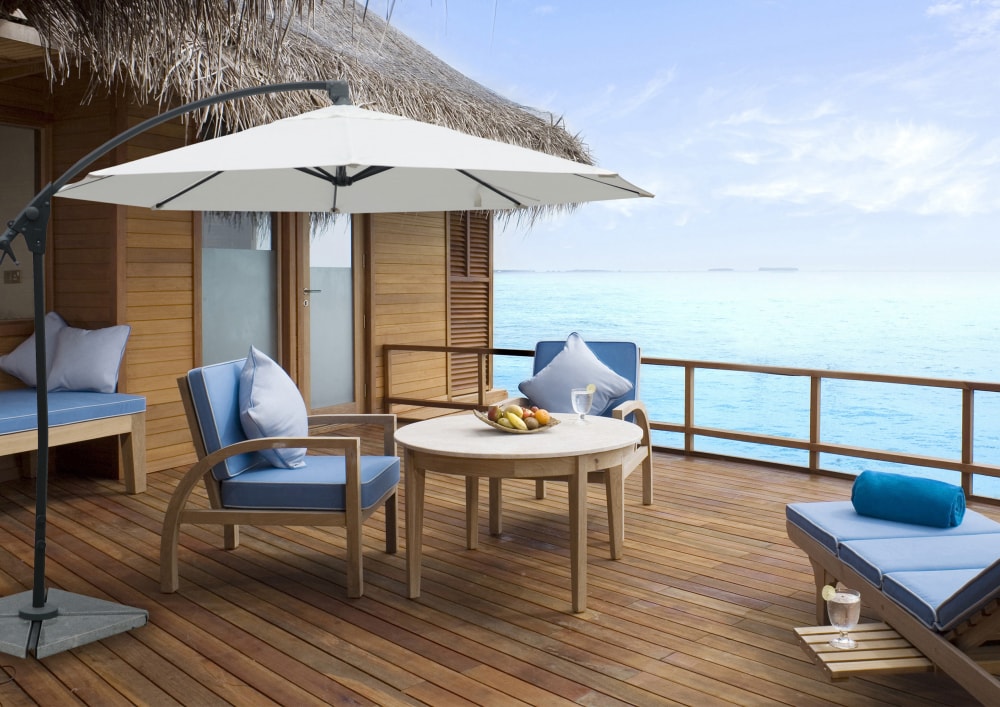
Hotel poolside application reference: shade structures around an outdoor pool deck. Fixed-awning performance referenced against ASTM E330 structural loading. Source: QIAHE Umbrella.
Common Mistakes Hotel Buyers Make When Sourcing Poolside Shade
These are the failure modes I see most often when a buyer comes back to us after a project that did not go smoothly. I list them here because avoiding them is cheaper than fixing them, and because I have watched each of these mistakes burn real project budget. I keep this on a printed list inside our sample room for the same reason — every new buyer who walks through our door sees it before we look at product. I also share it with our OEM partners, because the mistakes are usually not about the product itself; they are about the specification and the planning.
- Choosing a solution from a brochure. The wrong choice usually starts with a brochure picture that looked good in the sales meeting. Because the brochure does not show the wind, the property ends up with a beautiful awning that fails the first time a coastal storm rolls through.
- Skipping the wind check. Buyers sometimes specify an umbrella without asking the supplier for the rated wind speed and the test method. Because the rated wind speed defines the daily closing protocol, skipping this number means the property has no protocol at all.
- Specifying the wrong base. A cantilever umbrella with the right canopy and the wrong base is a liability. Because the base carries the bending load of the canopy, the base weight and anchoring method must match the deck surface and the wind exposure.
- Forgetting the permit cycle. Buyers sometimes assume a fixed awning can be installed in the same timeline as an umbrella. Because the awning needs a permit and possibly engineering documentation, the procurement timeline is longer and should be planned from the start.
- Treating fabric as a one-time purchase. The fabric reaches end of life first, usually before the frame. Because the fabric is a recurring cost, it belongs in the multi-year maintenance budget from the moment the system is specified. I usually ask the buyer to budget for two fabric cycles in the first ten years of ownership, because that is what I have actually seen across our commercial deployments.
Field Notes From Our Project Desk
Over the years I have collected a few patterns that show up again and again when hotel buyers bring us a pool deck project. I share them here because they tend to save project time, and because they are the kind of details that never make it into a brochure. I update this list every quarter based on what I hear back from the property teams after the umbrellas and awnings have been running through a season.
- Always quote the wind rating on the data sheet. When I review a buyer’s specification, I ask for the rated wind speed and the test standard. Because the rated wind speed is the single most important number, it has to be on the data sheet, not buried in a brochure footnote. I also ask for the test report from the supplier’s lab, because rated figures without a test reference are easy to copy and impossible to defend.
- Keep the fabric weight in mind for coastal sites. Salt air shortens fabric life. I recommend 280 g or heavier PU-coated polyester for coastal properties and 250 g PA-coated polyester for inland properties. Because salt air accelerates UV degradation, the heavier fabric pays back in longer replacement cycles.
- Plan the closing cycle into the daily SOP. The rated wind speed only matters if the property actually closes the umbrella above that threshold. I always ask buyers to write the threshold into the property SOP before the umbrella is delivered. I have seen properties lose a full season of fabric because no one wrote the SOP down and the night team assumed the morning team would do it.
- Match the base to the deck surface. Concrete decks take a bolted base. Timber decks need a weighted plate to avoid fastener pull-out. Because the base is the only thing keeping the umbrella upright, the right base is non-negotiable. I have walked buyers off the wrong base twice this year alone, and I now ask for a photo of the deck before I quote any base.
- Treat the deck as one project, not two. The umbrella and the awning together are the shade system. Because they share the same wind environment and the same maintenance team, they should be specified together and reviewed together. I usually ask the buyer for one combined quotation rather than two separate ones, because that is the only way to keep the wind rating, the fabric specification, and the timeline aligned.
Frequently Asked Questions About Hotel Poolside Shading
Which is better for a hotel pool deck, a cantilever umbrella or a fixed awning?
It depends on the layout. Cantilever umbrellas are best where the deck is irregular, where the shade footprint needs to follow the sun across the day, and where the property wants a portable, repositionable solution with no structural attachment to the building. Fixed awnings are best where the deck has a continuous edge along one wall, where the property wants permanent weather protection over a known footprint, and where the wind exposure of the site is well documented. Most hotel projects I work on end up combining both: a fixed awning for the primary guest-facing perimeter and cantilever umbrellas for the open pool surface.
How much wind can a commercial cantilever umbrella handle?
A well-engineered commercial cantilever umbrella is typically rated for 30 to 50 km/h steady wind with the canopy deployed, depending on the rib geometry, base weight, and fabric tension. The umbrella must be closed and secured above that range. Always verify the rated wind speed on the supplier's data sheet and match it to the design wind speed of the site.
What footprint does a fixed awning cover?
Standard residential and light commercial retractable awnings project 2.0 to 4.0 m outward from the wall, with widths of 2.5 to 6.0 m, giving a covered footprint of roughly 5 to 24 m² per unit. Heavy commercial fixed-frame awnings can project further when paired with supporting columns or leg tubes, and multiple units can be joined to span longer runs.
Do cantilever umbrellas require a building permit?
In most jurisdictions, cantilever umbrellas are classed as furniture or movable shade structures and do not require a building permit, but local rules vary. Fixed awnings attached to the building envelope usually do require a permit and may need engineering documentation. We recommend buyers confirm with the local building authority before procurement, especially for hotel projects where accessibility and egress rules apply.
How long do commercial outdoor umbrellas last in a hotel environment?
With proper care, a commercial cantilever umbrella with an aluminum frame and acrylic or polyester fabric typically lasts 5 to 10 years in a hotel pool environment. The fabric usually reaches end of life first because of UV exposure, salt air, and chlorine mist. The aluminum frame and hardware typically outlast two or three fabric cycles if rinsed regularly and stored during storm season.
Can a hotel install either solution without taking the pool out of service?
Yes. Cantilever umbrellas are installed around the deck with hand tools and a small base pour, which we typically schedule overnight or during off-peak hours. Fixed awnings need wall anchoring and may require scaffold access, so the timing is longer but rarely disruptive to a closed pool area. We plan installations around the property's low-occupancy windows and document the schedule before any drilling begins.
Which solution is easier to rebrand when the hotel refreshes its visual identity?
Both can be rebranded. Cantilever umbrellas accept printed fabric panels and replacement valances, which makes a full rebrand relatively cheap. Fixed awnings usually require a full fabric replacement, which is more invasive but allows for larger graphic panels and signature colors. In my experience, properties that rebrand every three to five years tend to lean toward cantilever umbrellas because the fabric change is faster and cheaper.
What I Tell Every Buyer on the First Call
If I could leave you with a short list of questions to answer before you approach any supplier, it would it be this:
- Where does the building end? That line defines which side of the deck is the awning’s job and which side is the umbrella’s job.
- Where does the wind come from? That answer sets the rated wind speed you must specify, and therefore the base weight and the anchoring method for the umbrella.
- What does the deck look like at noon and at 4pm? That comparison tells you whether the shade needs to track the sun or hold a fixed footprint.
- Who owns the daily closing protocol? If no one owns it, the umbrella will not be closed on time. I have seen this exact question decide whether a project succeeds or fails in its first storm season.
- What is the fabric replacement date? Write it into the property’s asset register the day the system is installed. Five years goes fast, and the property will be grateful for the reminder.
I keep this list on the desk in our sample room. I have walked more than a few buyers through it on the first call, and I have watched the conversation settle as soon as we work through those five questions together. Because the right shade system is the one that matches the deck, not the brochure, those five answers do more than any product specification sheet. I usually send the buyer home with a printable copy of the list, so they can walk the deck in person before we speak again.
Where QIAHE Fits in Your Pool Deck Project
QIAHE supplies commercial cantilever umbrellas, aluminum awnings with leg tube support, manual and electric aluminum awnings, and a wider outdoor hospitality line including carports, gazebos, inflatable tents, and greenhouse structures. We support OEM and ODM custom manufacturing, helping global retailers and distributors source durable, weather-resistant outdoor structures with confidence.
If you are evaluating shade for a hotel pool deck, the fastest path is to send us the deck outline, the prevailing wind direction, and the targeted shade coverage. Tell us the deck dimensions and the wind rating you need, and we will line up the umbrella, the awning, or the combined system that matches your site. I read every inquiry myself and route it to the right engineer on our team, so you get a technical reply within one business day. From there, we usually move to a written quotation with the data sheet attached, and from there to a sample shipment if the property wants to see the fabric in the hand before placing the production order. I find that buyers who request a sample first almost always end up with a better specification, because the sample tells them things the data sheet cannot.
Request a Sample and Project Quote
If you are evaluating cantilever umbrellas, fixed awnings, or a combined shade system for a hotel pool deck, request a quote with deck dimensions and the targeted wind rating.
Request a Quote & Sample View Cantilever Umbrellas View AwningsAlice
Outdoor Product Specialist, Ningbo Qiahe Outdoor Products Co., Ltd. (QIAHE)
“A shade structure that does not survive the first storm is not a hospitality investment — it is a liability in matching upholstery.”
Alice is an outdoor product specialist at QIAHE, a professional manufacturer and exporter with 20+ years of experience in carports, awnings, gazebos, inflatable tents, and greenhouse solutions. Alice supports OEM and ODM custom manufacturing, helping global retailers and distributors source durable, weather-resistant outdoor structures with confidence. Alice routinely walks buyers through both cantilever umbrellas and fixed awnings on the same call, because in her experience the two products almost always appear together on the same hotel brief.