




Manual vs Motorized Retractable Awnings: 5-Year Cost of Ownership
- Motorized retractable awnings carry a higher upfront cost — but the motor adds convenience that correlates with more consistent real-world usage, which is where the weather-protection investment actually pays off
- Fabric replacement cycles are identical across both mechanisms; usage frequency and local UV index determine longevity, not whether the unit is cranked or motorised
- Annual electricity cost for a motorized awning motor is negligible — in the low single-digit dollar range per year at standard residential tariffs
- The case for manual is strongest at lower mounting heights, seasonal-use scenarios, and tight upfront budgets; the case for motorized is strongest at height, for daily-use patios, and where wind-sensor automation is desired
- Over five years, total cost of ownership converges significantly once motor replacement and fabric replacement are factored in for both types
The Core Question: Upfront Cost vs. Real-World Usage
Every retractable awning purchase decision ultimately reduces to one question: does the motorized mechanism deliver enough practical value to justify its additional upfront cost over a full ownership cycle? The answer is never simply "yes" or "no" — it depends on how often you will actually use the awning, how high it is mounted, and how much you value the automatic weather-response capability that only a motorized system with a wind sensor can provide.
In my experience working with commercial clients who install awnings across restaurant patios and retail terraces, the motorized units consistently show higher deployment frequency in practice. Because the physical effort of cranking a manual unit—even a well-designed short-arm crank—creates a friction point that reduces spontaneous deployment, customers who choose manual often report that their awning spends more time retracted than they originally anticipated. This matters because an awning that is not deployed cannot deliver its intended value: UV protection, heat reduction, or rain shelter.
The OSHA sun protection guidelines for outdoor workers note that shade structures are among the most effective passive UV protection measures available, but only when they are actually in use. This principle extends directly to residential and commercial patios: an awning that stays rolled up delivers zero UV protection.
Year 1: Upfront Hardware and Installation Cost
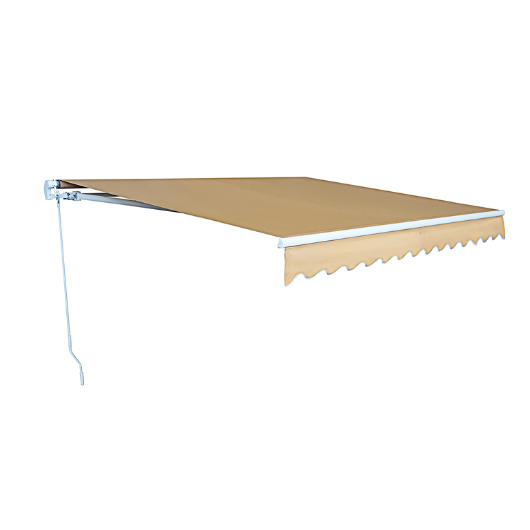
The upfront cost comparison is the most visible difference between the two options. For a given frame size, fabric grade, and projection length, a motorized retractable awning costs more than a manual crank equivalent. The gap reflects the motor assembly, the control hardware (wall switch or remote), and the additional manufacturing complexity of the roller tube that must house the motor without compromising the fabric roll.
For standard residential installations in the 3-metre to 5-metre width range, the motorized version typically sits at a qualitative premium over the manual version of the same product series. Because installation labour cost is identical for both mechanisms—same wall bracket mounting, same structural fixing—the percentage gap in total installed cost is slightly narrower than the gap in hardware price alone.
QIAHE offers both manual crank and motorized versions across its full aluminum retractable awning range, allowing buyers to compare feature levels directly within the same quality tier. The retractable canopy series additionally covers heavier commercial-grade projections where the structural requirement naturally favors the motorized option.
Years 2–3: Maintenance, Repairs, and Usage Patterns
By the second and third year of ownership, the maintenance picture begins to diverge. A manual crank awning has more exposed mechanical joints—the crank gearbox, the lateral arm joints, the support brackets—and these can show wear in high-usage scenarios. Because the arm tension chain and spring mechanism in a manually deployed awning are under constant load whenever the unit is extended, unexpected extension under wind load can accelerate hardware wear at the elbow joints.
A motorized awning's arm system operates identically once deployed, but the deployment mechanism itself is sealed inside the roller tube. Because there are no user-accessible mechanical joints in the motor assembly, the primary maintenance event in this period is battery replacement for the remote control or wall switch — an annual cost comparable to a smoke detector battery. Wind and sun sensors, if equipped, should be calibrated annually; this is a simple adjustment that does not require specialist tools.
The National Weather Service UV Index data shows that UV intensity in subtropical and Mediterranean climates regularly reaches the high and very high categories during summer months. Because UV degradation of fabric is cumulative and proportional to exposure time, an awning that is deployed consistently during these months will reach its fabric service-life limit sooner than one used only on overcast days — regardless of whether it is manual or motorized.
Years 3–4: Fabric Replacement — The Great Equaliser
Fabric replacement is the great equaliser in the five-year cost comparison. Whether your awning is manual or motorized, the fabric will eventually require replacement — and the cost of the new fabric and the labour to install it is the same regardless of which mechanism rolls it up. Acrylic fabric in a high-UV climate typically enters the replacement conversation in the third to fifth year of service, depending on colour density, fabric weight, and UV exposure hours.
For PVC-coated polyester, the timeline can be longer, but surface chalking in years four and five is common in sunny climates. Because the ASTM D 4796 standard for tarpaulins measures physical property retention after accelerated weathering, it provides a reference framework for understanding how fabric grade translates to service life expectations — though the standard applies to the fabric itself, not to finished awning products.
In a manual awning, there is one subtle fabric longevity factor worth noting: because the effort of cranking reduces spontaneous deployment, manually operated awnings tend to spend more time retracted. Because retracted fabric is shielded from direct UV radiation, this reduction in daily UV exposure can marginally extend the fabric service life compared to a motorized unit used identically. In practice, this effect is modest — the difference in fabric replacement timing is typically less than one season — and it does not offset the other usage-value factors that favour motorized deployment.
Year 4–5: Motor Replacement and Residual Value
By the fourth or fifth year, a motorized awning owner may face the motor replacement question. Residential-grade tubular motors carry rated cycle lives in the low four-figure to mid four-figure range of full extension-retraction cycles. Because most households deploy and retract their awning once or twice per day on average, a motor rated for several thousand cycles will typically last beyond the five-year mark — but this varies by manufacturer, motor class, and usage frequency.
Commercial-grade motors — which QIAHE specifies for its heavy-duty commercial awning range — are rated for significantly higher cycle counts and carry longer warranties. Because motor replacement labour involves disassembling the roller tube and re-terminating electrical connections, it is a skilled task that typically requires an authorised service agent or a qualified awning technician. For this reason, specifying a motor with a longer warranty at purchase time is almost always better economics than accepting a lower upfront motor cost in exchange for a shorter warranty period.
Energy Impact: The Overblown Concern
One of the most common objections I hear to Motorized Awnings is the electricity cost. In practice, this concern is greatly overblown. A tubular DC motor for a residential retractable awning draws in the low two-figure watt range during a deployment or retraction cycle that lasts under a minute.Because the motor operates for less than one minute per cycle and only during deployment or retraction — not continuously — the total annual energy consumption is measured in the low single-digit kilowatt-hours.
At a typical residential electricity tariff, this translates to a cost in the low single-digit dollar range per year. Because this cost is incurred only when the awning is deployed or retracted (not while it stands extended), even frequent daily use adds a negligible amount to the electricity bill. The EPA sun safety guidance notes that the health and comfort value of consistent shade use significantly outweighs any minor energy cost of automated deployment.
The Five-Year Summary: Where the Math Lands
After five years of ownership, what does the total cost comparison actually look like? Here are the three variables where the two mechanisms diverge most meaningfully:
- Because the motorized unit typically sees higher deployment frequency, its weather-protection value per year of ownership is usually measurably higher — even though the per-deployment value is identical to the manual unit. The motorized awning's value premium is primarily a usage-frequency premium.
- Because fabric replacement cost is identical for both mechanisms, the fabric line item in the five-year cost is a wash. The awning owner who chooses manual expecting to save on fabric replacement will be disappointed.
- Because motor replacement in year four or five is a potential additional cost unique to the motorized unit, a buyer on a strict five-year budget horizon should factor this possibility into their decision calculus — though many motors outlast the five-year window with no issues.
For most residential buyers, the five-year cost difference between a manual and a motorized retractable awning of equivalent frame quality is not as large as the upfront price gap suggests. The motorized option's higher deployment frequency, automated wind response, and ease of use translate into more days of actual shade use — and in a climate where summer patio comfort is the primary use case, that is where the real value lies.
Frequently Asked Questions
QIAHE YouTube Channel
Ready to Compare Your Options?
QIAHE manufactures both manual crank and motorized retractable awnings across a wide projection and width range, with CE-certified hardware and OEM/ODM custom capabilities for commercial projects. Our team can provide a specification and quote based on your installation dimensions and usage requirements.
Get a Quote and SampleThis article is published by QIAHE for informational purposes only. The views expressed are the author's own. All product information is accurate as of the date of publication. This site respects your privacy: no cookies, no data retention.