







TL;DR
Rental-fleet owners choosing between pop-up folding tents and frame tents for event work make the call on five dimensions, not on the headline price of either unit. Setup time per crew-hour is the first number, but it is not the most important number; lifetime cost per square-meter-hour installed is. A pop-up tent typically goes from bag to standing in a fraction of the time of a frame tent, but it carries fewer options for anchoring, fewer modular add-ons, and a shorter service life under repeated commercial cycling. A frame tent takes longer to set and strike, demands a more experienced crew, and requires more truck space, but it survives more cycles, anchors in higher winds, and is easier to repair section-by-section when one part fails. This guide walks through the labor math, the cycling math, and the repair math that fleet owners actually run, then gives a sizing rule of thumb for which tent class fits which event book. The QIAHE Outdoor heavy-duty PVC event canopy and the matching pop-up folding tent lines are referenced as concrete examples, the folding gazebo category page shows the broader commercial line, the published cyclic wind loading risk assessment is the engineering anchor for the wind section, the products catalog gives fleet buyers the full SKU view, and contact QIAHE is the route for fleet buyers requesting quotation and printed samples.
Setup time: the headline number that hides the real cost
A standard 3 m x 3 m pop-up folding tent goes from bag to fully standing in roughly 60 seconds with a trained two-person crew, which is the number most rental brochures publish and the number every fleet owner hears first. A 3 m x 4.5 m frame tent of equivalent footprint takes roughly 20 to 30 minutes with a trained four-person crew, which is the number that makes frame tents look uneconomic at first glance. Both numbers are real, but neither is the number that drives fleet economics.
The number that drives fleet economics is "minutes per square meter installed per crew-hour billed." A pop-up at 60 seconds for two crew to install a 9 m² footprint equals roughly 30 crew-seconds per m². A frame tent at 25 minutes for four crew to install a 13.5 m² footprint equals roughly 440 crew-seconds per m². The pop-up is about 14x faster on this metric, which sounds decisive — until the rental day rate, the crew rate, and the cycle-count are folded in.
For a single-event rental, the pop-up math is almost always correct: short install window, low crew cost, low book value at risk. For a fleet that cycles tents 80 to 120 times per year and charges installation to the client, the math can flip once the frame tent's longer service life and lower per-cycle replacement cost is counted. The right answer is fleet-specific, not tent-class-specific, which is why this guide is structured as a comparison rather than a recommendation.
Crew size, skill floor, and labor math
Pop-up tents have a low skill floor. Two crew with no prior experience can deploy a 3 m x 3 m pop-up after a 15-minute walkthrough, and most of that walkthrough is the leg-pinning sequence and the ballast or staking decision. Frame tents require a higher skill floor: four crew with at least two to three supervised setups under their belt before they can deploy without supervision, and the deployment includes crossbar sequencing, joint pinning, fabric pull-through, and tensioning. The skill gap shows up as labor cost: pop-up crews can be drawn from event-day general labor, frame-tent crews usually need at least one senior installer per four-person team.
The fleet-level labor math depends on the local labor market and on the install rate the rental company charges. As a benchmark, when the install rate passed to the client is below the cost difference between a four-person frame crew and a two-person pop-up crew, frame tents are economically hard to justify on labor alone. When the install rate is above that threshold, frame tents become attractive even though the headline minutes are higher, because the higher install rate covers the higher crew cost and the longer service life and the lower per-cycle replacement cost compound the advantage over the tent's lifetime. The exact break-even rate is fleet-specific, but the direction of the answer is consistent: high install rate favors frame, low install rate favors pop-up.
Crew training also affects insurance exposure. Frame-tent setups often trigger OSHA 1926 construction-safety rules when installed on commercial sites, and a trained senior installer reduces the chance of an accident that would land in the fleet owner's general liability record. Pop-up setups, by contrast, are usually treated as event-day setup under IFAI event-fabric guidance, which is a lower-friction regulatory path. Fleet owners who carry their own insurance should price the difference, because the premium impact is real even when the headline setup minutes look small.
Wind, weather, and the cycle-count problem
The single most underestimated cost in a rental tent fleet is the cycle-count cost: the depreciation, the maintenance, and the field-failure exposure of every install-strike cycle. Pop-up tents use scissor-joint frames that flex under wind load, and the published engineering literature on this topic, including QIAHE's cyclic wind loading risk assessment for pop-up canopy frame joints, treats the joint as the cycle-limiting component. Aluminum scissor joints in commercial-grade pop-ups typically rate for a finite number of open-close cycles before the rivet holes elongate and the joint develops play. Frame tents, by contrast, use bolted or pinned aluminum or steel tubes that wear more slowly because the wear surface is the pin, which is a cheap serviceable part, not the joint body, which is the expensive structural part.
For a fleet owner, the operational consequence is that a pop-up tent's safe service life is bound by the joint cycle count, and a frame tent's safe service life is bound by the fabric UV degradation, which is much longer. Wind rating compounds this: pop-up tents are typically rated for winds in the 30 to 50 km/h range with proper ballasting, frame tents in the 80 to 100 km/h range with proper staking. A fleet operating in a coastal, plains, or mountain-wind market will see pop-ups declined for hire on more days than frame tents, which is a revenue-side cost that rarely shows up in a per-unit price comparison. The photo-oxidative degradation mitigation guidecovers the fabric-side of that lifetime calculation for fleet owners comparing Canopy replacement intervals.
The wind-rating dimension maps directly onto ASCE 7 wind-load provisions for temporary structures, and the flame-spread dimension maps onto NFPA 102 standard for assembly occupancies (mercantile and tent-event applications) and CPAI-84 for canvas-products flammability, both of which appear in the safety binders of commercial fleet buyers in the US market. In the EU market, EN 13782 is the equivalent temporary-structures standard. Fleet owners operating across both regions often standardize to the stricter of the two and accept the unit-cost premium as a market-access cost.
Transport, stowage, and truck-pack density
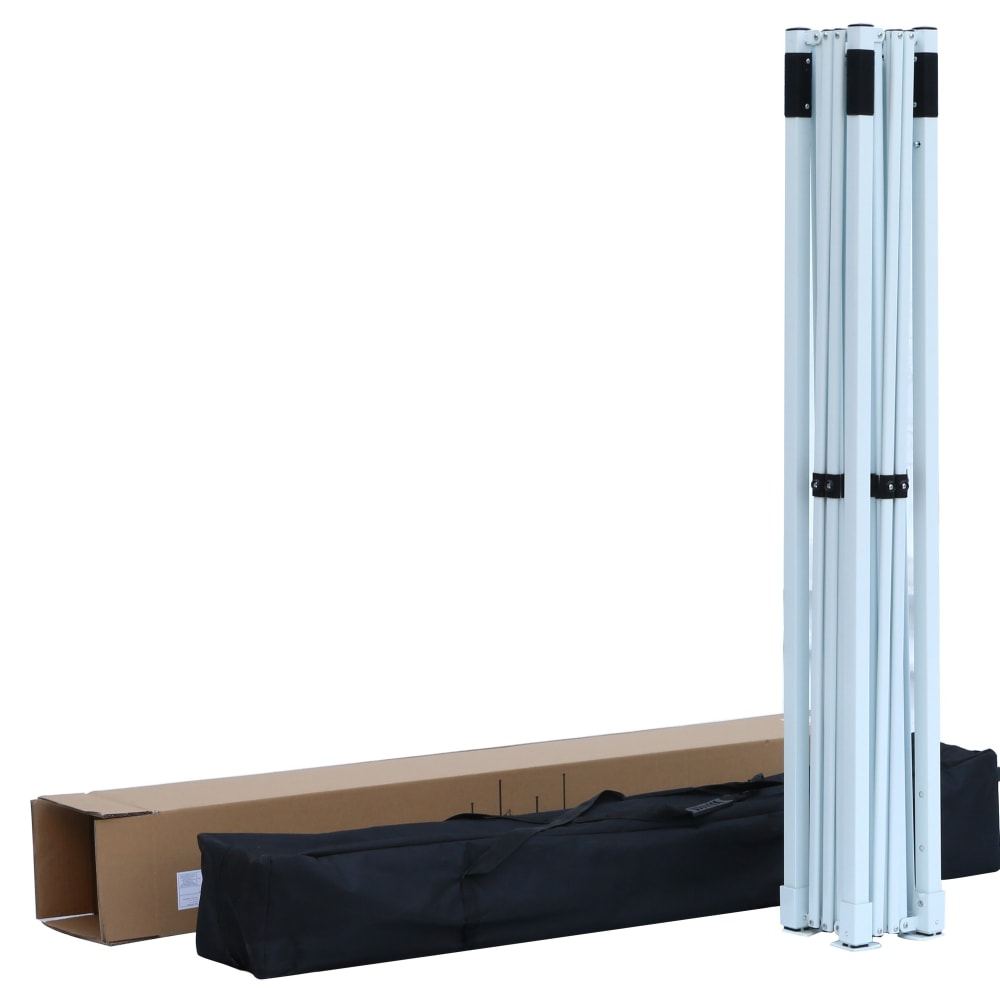
Pop-up tents fold into a wheeled carry bag that fits in the trunk of a sedan or in a side compartment of a cargo van. Frame tents pack into multiple long bags and crates that usually require a box truck or a trailer. For a fleet owner running same-day small events from a single depot, the pop-up logistics profile is dramatically cheaper: one vehicle, fewer drivers, fewer return trips. For a fleet running multi-day large events with a base camp and a fleet of vehicles, the frame-tent logistics profile is more efficient because the cubic-meter-per-truck-pack density is actually higher for frame tents than for pop-ups once the unit count rises.
The rule of thumb is that a pop-up fleet makes economic sense up to about 60 to 80 units, after which the truck-pack efficiency of frame tents overtakes the labor savings of pop-ups. Below that threshold, pop-up logistics wins. Above it, frame logistics wins. The exact threshold depends on the local crew rate, the vehicle cost, and the average booking size, but the direction is consistent. Fleet buyers who also stock complementary categories — carport, gazebo, or inflatable tent lines — see the same truck-pack logic apply across the broader catalog, which is why the transport conversation usually surfaces as a fleet-wide decision rather than a single-category decision.
Truck-pack density itself follows the same pattern across USDOT FMCSA hours-of-service rules for commercial drivers — fleet owners running their own trucks have to plan install-strike cycles within driver-hour limits, which pushes the math further toward frame tents for multi-day events that require overnight stays on site.
Lifetime cost per square-meter-hour: the right comparison metric
The metric that resolves the pop-up vs frame question is lifetime cost per square-meter-hour installed, calculated as (purchase price + cumulative maintenance + cumulative failure-replacement cost + cumulative install labor cost) divided by (square meters × cycles × years). For a fleet owner, the answer collapses into a single number that can be compared across tent classes without arguing about setup minutes in isolation.
A representative fleet calculation: a low-cost pop-up that lasts on the order of 150 cycles and deploys in 60 seconds with two crew sits at one lifetime cost number; a higher-cost frame tent that lasts several hundred cycles and deploys in 25 minutes with four crew sits at another. The frame tent costs more per unit and more per install but costs less per square-meter-hour installed, which is the metric that the client eventually pays for. Fleet owners who run the lifetime calculation end up with a mixed fleet — pop-ups for short-cycle, small-footprint, low-stakes events; frame tents for long-cycle, large-footprint, high-stakes events. The fleet composition is what scales, not the per-unit decision.
Worked comparison: a 50-unit fleet over five years
A fleet owner with 50 tent slots faces the choice of 50 pop-ups, 50 frame tents, or a mix. Running the lifetime cost over five years with representative assumptions: 50 pop-ups at the lower unit price plus five years of joint-cycle replacements and field-failures total roughly 1.5x the original purchase price over the cycle life, deployed for an average 80 events per year, generate a total install labor cost equal to roughly 25% of the cumulative book value. 50 frame tents at the higher unit price plus five years of fabric UV replacement and pin-replacement total roughly 0.4x the original purchase price over the cycle life, deployed for the same 80 events per year, generate a total install labor cost equal to roughly 90% of the cumulative book value.
The headline numbers favor pop-ups on unit cost and on labor cost. The lifetime cost per square-meter-hour installed is roughly comparable between the two pure-fleet options, but with a critical difference: the pop-up fleet is exposed to weather-decline days that the frame fleet is not, which adds a hidden revenue-side cost. The mixed-fleet option (about 20 pop-ups for small event days and 30 frame tents for medium and large event days) typically outperforms both pure-fleet options on lifetime cost per square-meter-hour, which is the conclusion that the lifetime calculation almost always reaches when it is run honestly.
A 5-question decision rule for the next fleet purchase
Before adding any unit to a rental tent fleet, answer these five questions. Each question has a yes/no answer that points toward pop-up, frame, or mixed:
- Is the average event footprint below 9 m² and the average event duration below 8 hours? Yes points toward pop-up. - Is the average event book above the labor-cost spread threshold, with the install rate passed to the client? Yes points toward frame. - Does the operating market see wind events above 50 km/h more than 8 days per year? Yes points toward frame. - Is the depot-to-event distance below 50 km round trip and the average booking size below 30 units? Yes points toward pop-up. - Is the fleet expected to exceed 60 to 80 units in the next 24 months? Yes points toward frame.
A fleet that answers yes to 3 or more of these questions should mix the two classes rather than committing to one. The mixed-fleet answer is usually the right one because it lets each class play to its strength.
Closing: tent class is a fleet decision, not a unit decision
The pop-up vs frame question is not a question about which tent is better; it is a question about which class of events the fleet is built to serve. Pop-ups win on unit cost, on labor simplicity, on logistics for small fleets, and on the speed that small event days require. Frame tents win on cycle life, on wind rating, on repairability, on logistics for large fleets, and on the install rate that large event days can support. The fleet owner's job is to read the event book, run the lifetime calculation honestly, and pick the mix that minimizes cost per square-meter-hour installed. QIAHE Outdoor's heavy-duty PVC event canopy line supports the frame-tent side of that mix, the pop-up folding tent line supports the pop-up side, the broader folding gazebo category covers the mid-cycle commercial SKUs that fill the gap between the two extremes, the cyclic wind loading risk assessment is the engineering anchor for the wind and cycle discussion, and contact QIAHE is the route for fleet buyers requesting a printed quote and a fabric swatch against a specific fleet spec.
Discuss your fleet spec with the QIAHE engineering team
For fleet quotation, fabric swatches, or frame-joint testing against your operating market, the engineering team responds against your fleet profile rather than against a generic price list.
FAQ — Frequently Asked Questions
Lifetime cost per square-meter-hour installed, which folds purchase price, maintenance, failure replacement, install labor, and cycle count into one number. Setup time in isolation hides the cycle-life and labor-cost dimensions that drive fleet economics.
A 3 m x 3 m pop-up folding tent deploys in roughly 60 seconds with a trained two-person crew. The number sounds decisive but the comparison metric is minutes per square meter installed per crew-hour billed, not minutes per tent.
A 3 m x 4.5 m frame tent deploys in roughly 20 to 30 minutes with a trained four-person crew. Frame tents require a higher skill floor and at least one senior installer per team for unsupervised setups.
Commercial pop-up tents are typically rated for 30 to 50 km/h with proper ballasting; frame tents are typically rated for 80 to 100 km/h with proper staking. Wind rating affects the number of decline days per year, which is a hidden revenue cost for pop-up-heavy fleets in coastal or plains markets.
Pop-up scissor-joint frames flex under wind load and the rivet holes elongate with each cycle. Frame tents use bolted or pinned tubes that wear on the pin, which is a cheap serviceable part. Cycle life is the cycle-limiting dimension and is usually longer for frame tents by a factor of three or more. The QIAHE cyclic wind loading risk assessment treats the joint as the cycle-limiting component.
Below 60 to 80 units, pop-up logistics wins on vehicle cost and crew simplicity. Above that threshold, frame-tent truck-pack density overtakes the labor savings of pop-ups and frame logistics wins.
Yes, and the mixed fleet usually outperforms either pure-fleet option on lifetime cost per square-meter-hour installed. Pop-ups cover small event days; frame tents cover medium and large event days; the two classes play to complementary strengths.
QIAHE Outdoor's contact page routes specification and sample requests to the engineering team. The heavy-duty PVC event canopy line supports the frame-tent side and the pop-up folding tent line supports the pop-up side.
Cycle-count depreciation, because every install-strike cycle is a small structural event that compounds over the lifetime of the tent. Fleet owners who track cycles per unit per year end up with different replacement schedules than fleet owners who track calendar age alone.