




Roof Fabric Tearing in Heavy Gazebos: Prevention Through Material Spec
A tear in a heavy gazebo rarely starts in the middle of a panel. It starts at a stress point and propagates along a seam, which is why the specification that prevents tears is a specification of construction, not just of fabric weight.
TL;DR
- Tearing is a two-stage failure: initiation at a stress concentration, then propagation. The material specification can control both, because fabric construction decides how far a tear runs and reinforcement decides where one starts.
- Fabric weight is the headline number and the least informative one. The comparison that matters is 600D Oxford with a UV-resistant PU coating at a 1,500 to 3,000 mm hydrostatic head against 420D Oxford without it, and the published field difference in tear-related failure rate is under 3% versus 8% to 12% in high-sunshine markets.
- The frame fabric interface is a specification line, not a finishing detail. Powder coating is UV-tested at 1,000 hours with colour difference under 3 so that a chalking surface does not become an abrasive against the Canopy.
- Flame retardancy does not have to cost you tear strength. A CPAI-84 treatment at 5% to 8% by weight is independently tested to 1,000 hours of accelerated ageing with under 5% tear strength loss.
- A tear that happens on site is a parts question, not a product question. Our published commitment is 5-year spare parts availability with replacement canopies shipping in 7 to 10 working days.
When a commercial gazebo tears, the conversation that follows is rarely about the fabric, it is about who pays for the replacement, and that conversation starts from a specification that was never specific enough to compare two suppliers. Buyers ask for 600D because 600D is what everyone writes, then discover that the two quotes cover different coatings, different reinforcement and different frame finishes, and that the cheaper one is cheaper for a reason.
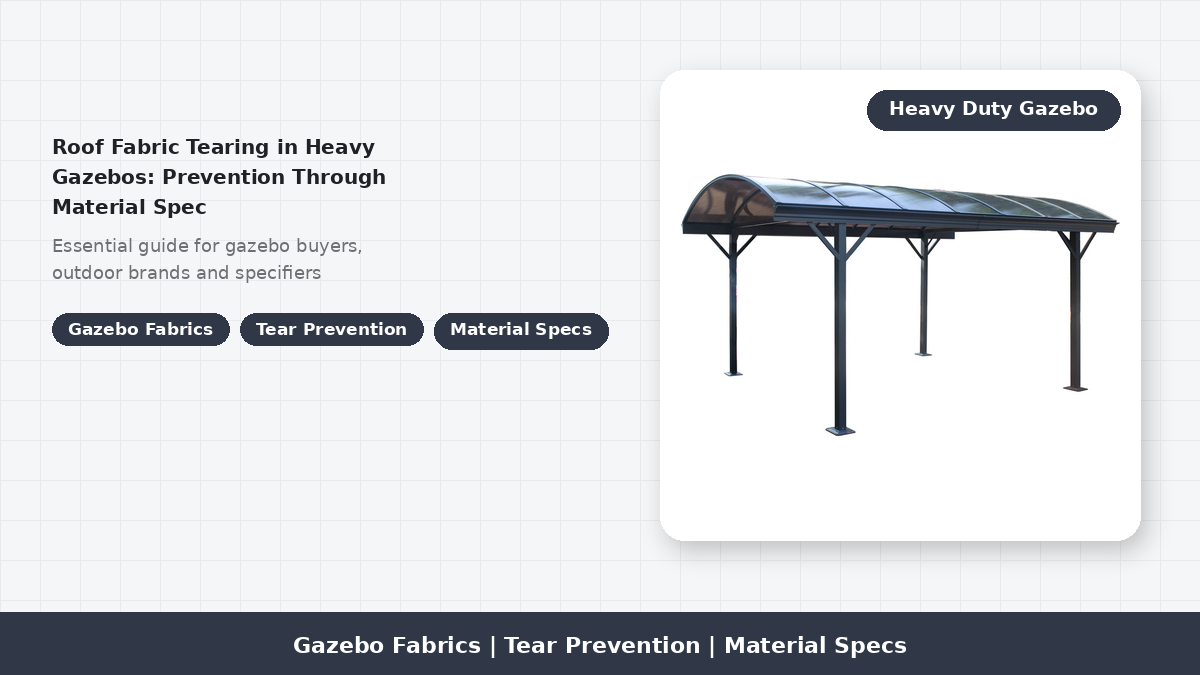
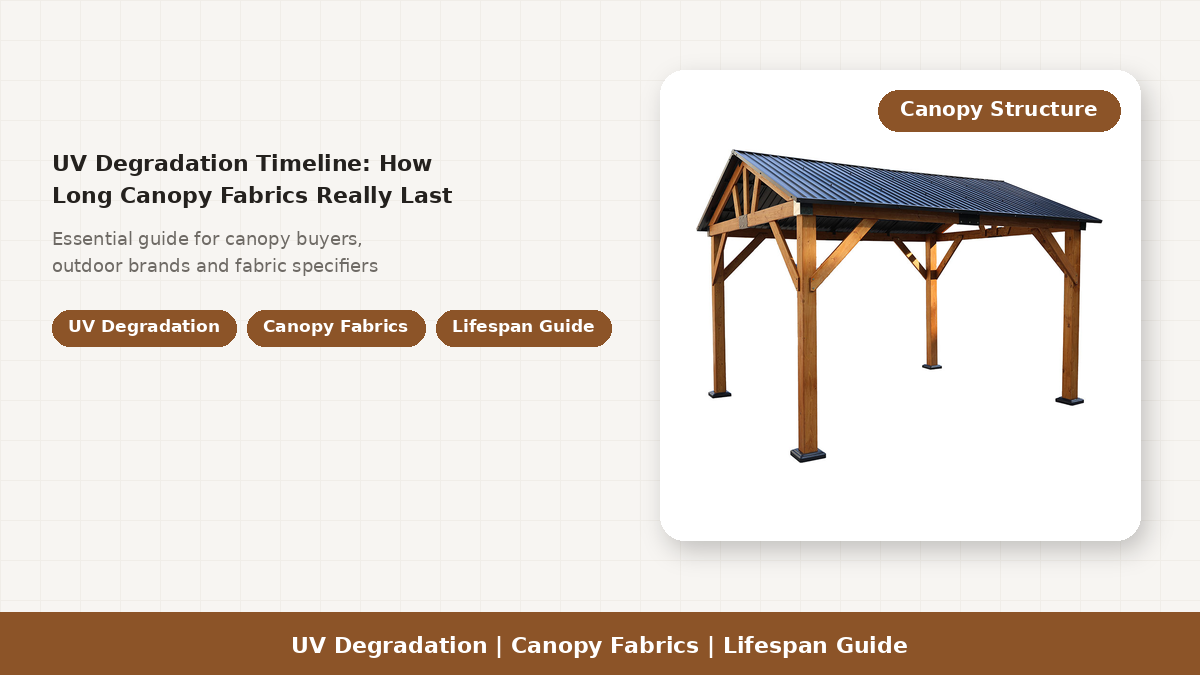
We manufacture carports, awnings, gazebos, Inflatable Tents and greenhouse structures, and 20 years of outdoor product work has taught us where gazebo fabric fails. This guide is built on the published material data behind our heavy gazebo range and on thehardtop gazebo with aluminum frame platform, with the companion piece on photo-oxidative degradation mitigation covering the UV chemistry in detail. Where a figure appears below, it comes from our own published pages.
Where a Tear Actually Starts
Fabric does not fail evenly, and a heavy gazebo concentrates its stress in a handful of places, which is why tears show up at corners, valances, eaves and hardware points rather than in the middle of a roof panel.
The failure has two stages. Initiation happens where the load is highest and the section is weakest, typically at a corner where a seam, a reinforcement patch and a frame member meet. Propagation happens next: once a slit exists, the remaining panel carries the load across that slit, the edges of the slit act as stress concentrators, and the tear runs along the weave or along a seam line until the panel is open.
Because the two stages have different causes, the prevention is split in two as well: the material specification decides how far a tear can travel, and the construction details decide whether a tear starts at all. A heavy fabric that is badly reinforced will tear early, and a perfectly reinforced panel on the wrong fabric will still run along its own seam line once the coating has aged.
The Material Specification, Field by Field
Here is the fabric specification as we write it, with the published values attached, so that two quotations can be compared line by line instead of paragraph by paragraph.
- Base cloth and weight. Our heavy canopies are built in 600D Oxford with a highly UV-resistant PU coating, and the comparison point is 420D Oxford without it. The field difference is what matters: in high-sunshine markets the stabilised 600D shows an annual tear-related failure rate under 3%, against 8% to 12% for standard 420D Oxford under identical conditions. We recommend the stabilised fabric for markets with more than 300 days of annual sunshine.
- Coating system and hydrostatic head. A PU coating at a 1,500 to 3,000 mm hydrostatic head, combined with a UV-resistant topcoat, gives flexibility and weatherproofing in a light construction. PVC laminates reflect UV better and resist heat ageing, tested at 70 °C for 168 hours to ASTM D573, which makes them the right choice for permanent installations rather than for seasonal or rental deployment.
- UV stabilisation chemistry. Hindered amine light stabilisers at 0.3% to 0.8% by weight act as radical scavengers, paired with benzotriazole-class UV absorbers at 0.2% to 0.5% that convert UV energy into thermal energy. The mechanism is covered in our companion guide; for specification purposes the entry is the stabilisation system and its concentration range.
- Colour and colourfastness. Colour fastness to artificial light to ISO 105-B02 is guaranteed at Grade 4 minimum, Pantone-matched dyeing uses a colour difference tolerance under 2.0, custom colours start at 100 pieces per size, and 30 by 30 centimetre swatches are supplied for approval before production. A specification that omits the tolerance is a specification argued about at goods-in.
- Flame retardancy. CPAI-84 certification is available as an add-on using a phosphorus-based treatment at 5% to 8% by weight, engineered so it does not degrade the UV stabilisers, independently tested to 1,000 hours of accelerated ageing with under 5% tear strength loss. The trade-off is a 10% to 15% reduction in breathability, which we offset with increased ventilation panel area in the structural design.
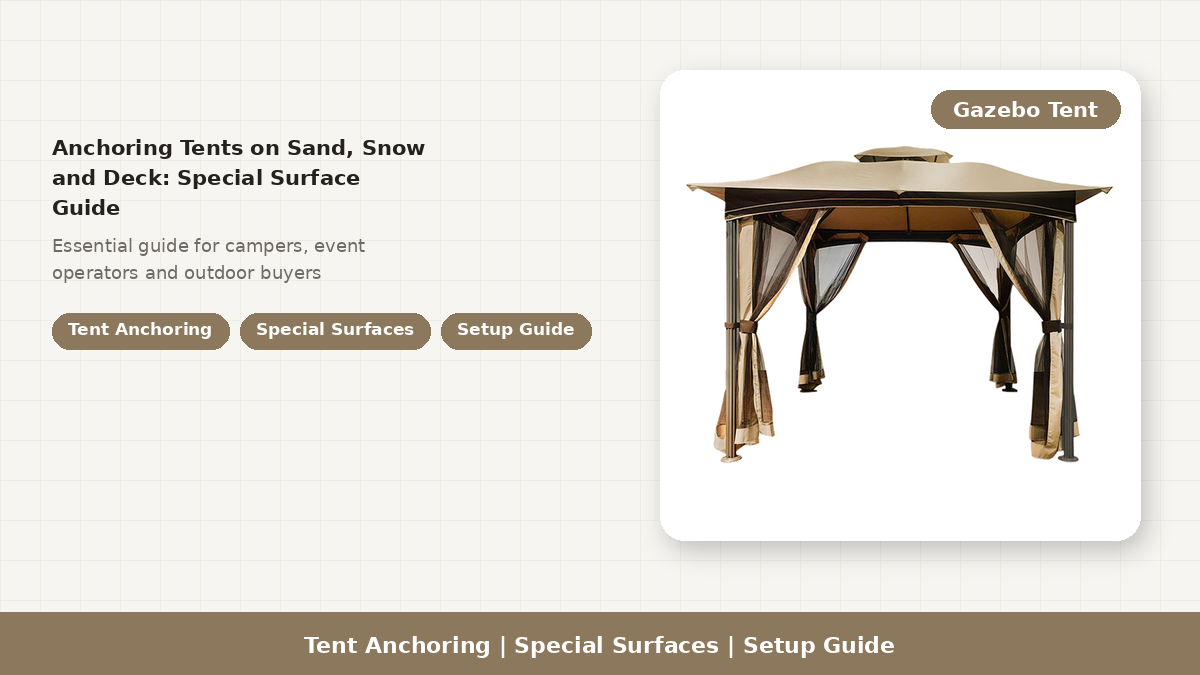
- Frame surface and the fabric interface.For steel frames the powder coating is UV tested to 1,000 hours with colour difference under 3, specifically so the coating does not chalk and become an abrasive friction point against the Canopy. Aluminum frames rely on anodized layer integrity to resist oxidation and to keep the interface with the fabric smooth. On our hardtop platform the published section sizes are a 125 by 125 by 1.4 mm aluminum leg tube, a 120 by 30 by 1.2 mm across tube and a 57 by 46 by 1.0 mm top tube, with mosquito nets, powder coating and painting.
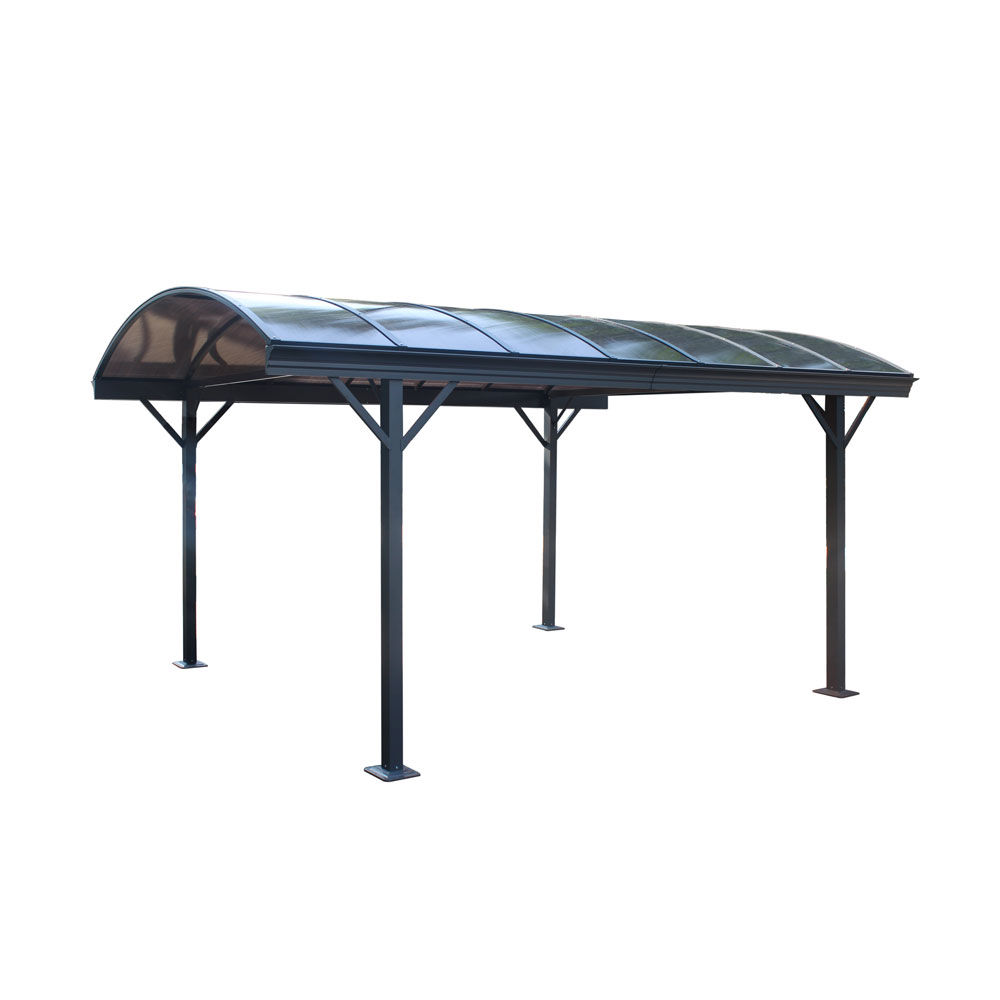
- Geometry, slope and drainage. Water sitting on a panel is a load and a thermal cycling cycle, so the roof profile is part of the fabric specification. The hardtop gazebo uses a sloped roof with built-in drainage holes so rainwater and snow flow away quickly instead of accumulating, and it carries fine mesh panels to keep insects out.
- Wind rating and anchoring. Our heavy gazebos, built with 40 mm steel tubes and reinforced corner joints, are rated to 60 km/h when properly ground anchored, and that rating drops to 40 km/h without anchoring. Independent wind tunnel test reports are available from SGS under NDA for qualified distributors. For the site wind load itself, the reference most codes use is ASCE 7, which is how a venue derives the speed a temporary structure has to be rated to.
- Service life of the parts. We commit to 5-year spare parts availability, with replacement canopies, frame tubes, connectors and foot plates stocked for 5 years after a model is discontinued, and parts orders typically shipping within 7 to 10 working days.
- Compliance framework. Our materials comply with ISO 105-B02 for colour fastness, EN 14151 for tent safety and CPAI-84 for flame resistance, supporting CE certification for EU market access. Where the fabric is used in regulated interiors, the flame propagation reference for textiles and films is NFPA 701, and for EU market access the chemical framework that applies to the treatment substances is the REACH Regulation (EC) No 1907/2006.
Because every one of these lines is a number a supplier can be held to, and because a quotation written against this template can be compared with any other quotation written against the same template, the specification is also the fastest way to remove price from the first round of negotiation and get to the real differences.
How to Write a Fabric Specification That Survives Goods-In
Seven items belong in the purchase specification, and a quote missing any of them is not comparable.
- Base cloth and weight, named together. 600D Oxford and 420D Oxford are not comparable lines; one of them is a specification and the other is a guess.
- Coating type and hydrostatic head, with the coating weight per square metre. PU and PVC serve different duty cycles, and the head value tells you which one you have been quoted.
- UV stabilisation system and the accelerated ageing protocol behind the claim.We publish ASTM G154 testing with UVA-340 lamps at 0.89 W/m² at 340 nm on an 8-hour UV and 4-hour condensation cycle, and the 2 to 5 year Canopy warranty is validated on 1,000 hours of that protocol.
- Colour tolerance, colourfastness grade and sample approval procedure. Colour difference under 2.0, grade 4 minimum, swatches approved before production.
- Flame certification scope, and what it does to tear strength and breathability. A certificate without the compound content and the tested configuration is a certificate for a different product.
- Reinforcement and interface details. Corner patches, valance construction, seam type, hardware attachment and frame surface finish, because initiation happens at these interfaces and not in the panel.
- Service and replacement terms. Parts availability period, shipping time and the documentation the rental fleet needs to service a unit on site.
Because the items on this list are the ones that generate claims, and because claims are what turn a distributor relationship into a dispute, the specification is cheaper to write now than the compensation is to settle later.
How to Order: What to Send Us
Seven details let us return a specification, a sample and a documentation pack rather than a catalogue page.
- Intended use and deployment cycle: permanent installation, seasonal, or rental fleet rotation.
- Size and configuration of the structure, and whether the fabric is a replacement Canopy or a new build.
- Climate: average sunshine hours, coastal exposure, and expected snow load.
- Anchor and ballast arrangement, because the published wind rating is conditional on anchoring.
- Colour requirement, Pantone reference and whether a custom colour is above 100 pieces per size.
- Certification scope required by your market, including flame certification and EU market access.
- Documentation scope: test reports, certificates of conformity, spare parts catalogue and the assembly documentation your service team needs.
We do not publish gazebo prices here, because fabric construction, coating, size, frame specification, colour and documentation scope all move the number, so the useful answer is a quotation against a written specification. Because the fabric specification is the document that governs the service life of the whole structure, we would rather agree it with you before anything is cut.
Frequently Asked Questions
1. Which fabric should a heavy gazebo canopy be specified in?
Our heavy canopies are built in 600D Oxford with a highly UV-resistant PU coating at a 1,500 to 3,000 mm hydrostatic head. The published field comparison in high-sunshine markets is under 3% annual tear-related failure rate for the stabilised 600D Oxford against 8% to 12% for standard 420D Oxford without UV coating under identical conditions, and we recommend the stabilised fabric for markets with more than 300 days of annual sunshine.
2. Should the canopy be PU coated or PVC laminated?
PU coating at a 1,500 to 3,000 mm hydrostatic head gives flexibility and weatherproofing in a light construction, which suits seasonal and rental use, while PVC laminates reflect UV better and resist heat ageing, tested to 70 °C for 168 hours to ASTM D573, which suits permanent installations. The choice follows the deployment cycle rather than the price.
3. Does flame retardancy cost tear strength?
Not meaningfully, if it is specified properly. Our CPAI-84 treatment is phosphorus-based at 5% to 8% by weight and is engineered so it does not degrade the UV stabilisers, independently tested to 1,000 hours of accelerated ageing with under 5% tear strength loss. The cost is a 10% to 15% reduction in breathability, which we offset by increasing the ventilation panel area in the structural design.
4. How is tear resistance validated before you ship?
With accelerated ageing protocols rather than with opinions: we use ASTM G154 with UVA-340 lamps at 0.89 W/m² at 340 nm on an 8-hour UV and 4-hour condensation cycle, and the 2 to 5 year Canopy warranty is validated on 1,000 hours of that protocol. Field data from high-sunshine markets then confirms the laboratory result against a published failure rate.
5. What wind rating can I put in a specification?
Our heavy gazebos, with 40 mm steel tubes and reinforced corner joints, are rated to 60 km/h with proper ground anchoring and 40 km/h without it, and independent SGS wind tunnel test reports are available under NDA for qualified distributors. For the site itself, ASCE 7 is the reference most codes use to derive the wind speed a temporary structure must withstand.
6. When a canopy tears in the field, what support is available?
Replacement rather than replacement of the whole structure. We guarantee 5-year spare parts availability, stock replacement canopies, frame tubes, connectors and foot plates for 5 years after a model is discontinued, and ship parts orders within 7 to 10 working days, with an exploded assembly catalogue so a rental fleet can service a unit on site.