



UV Degradation Timeline: How Long Canopy Fabrics Really Last
There is no single number for how long a Canopy fabric lasts. There is a degradation rate that depends on denier, coating, stabilizer chemistry and climate — and a manufacturer who quotes you a fixed lifespan is selling you a warranty, not an answer.
TL;DR
- Unmitigated polyester Canopy fabric can lose 30–50% of its tensile strength after just 1,000 hours of UV exposure, which is why tear propagation rather than fading is usually the first thing a customer notices.
- The defensible answer is a rate in a named climate, not a lifespan in years. Our field data shows an annual tear-related failure rate below 3% for UV-stabilized 600D Oxford with a UV-resistant PU coating, against 8–12% for standard 420D Oxford without UV coating in the same market.
- Two chemistry systems do the work: hindered amine light stabilizers at 0.3–0.8% w/w as radical scavengers, and benzotriazole-class UV absorbers at 0.2–0.5% w/w.
- The coating decides the heat story, and PVC laminate heat aging at 70 °C for 168 hours to ASTM D573 is a different failure mode from a PU coating losing its hydrostatic head.
- Ask for the protocol, the irradiance and the field figure. QUV testing to ASTM G154 at 1,000 hours means something specific, and it means nothing without the lamp, the irradiance and the cycle.
The short answer: specify the Canopy against exposure and stabilizer chemistry, and validate the claim with a named accelerated aging protocol rather than a number of years. Our photo-oxidative degradation guidance sets out the mechanism and the mitigation, and this article sets out how to read it as a buyer or a distributor.
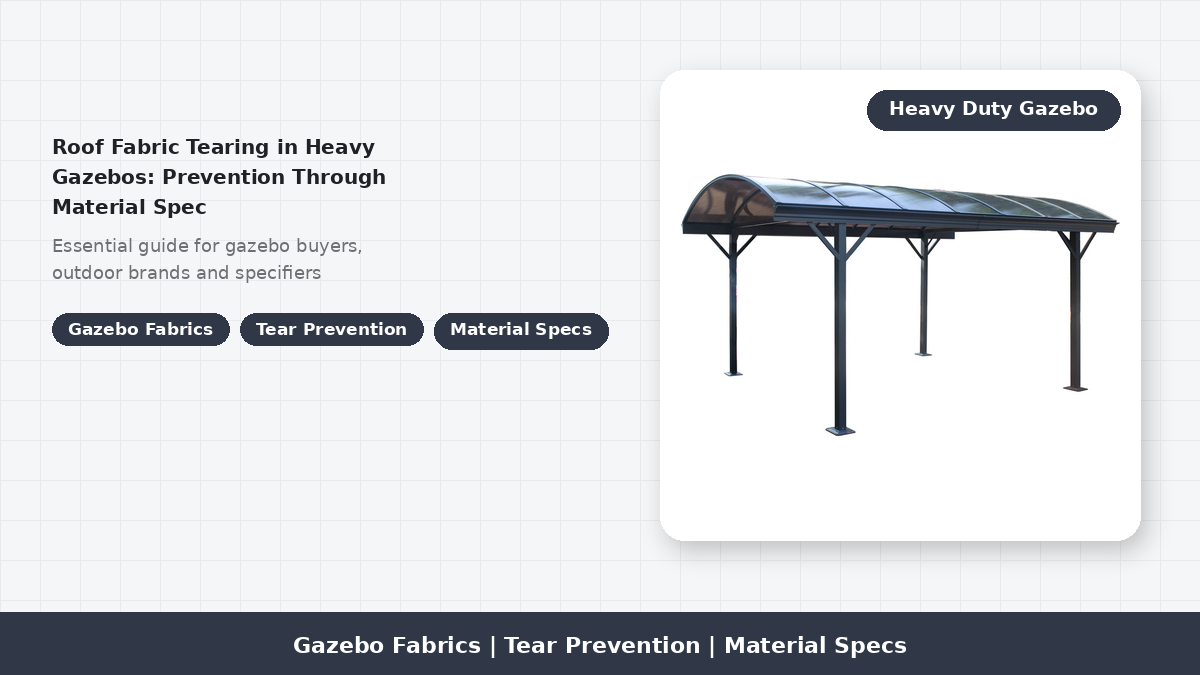
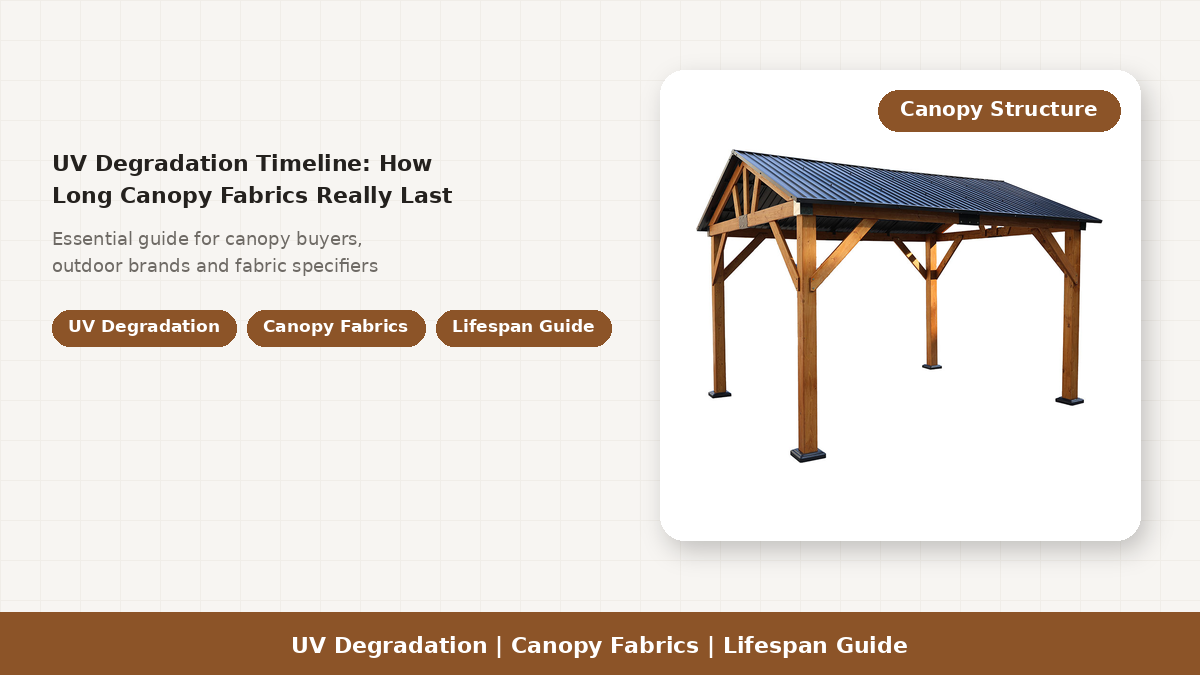
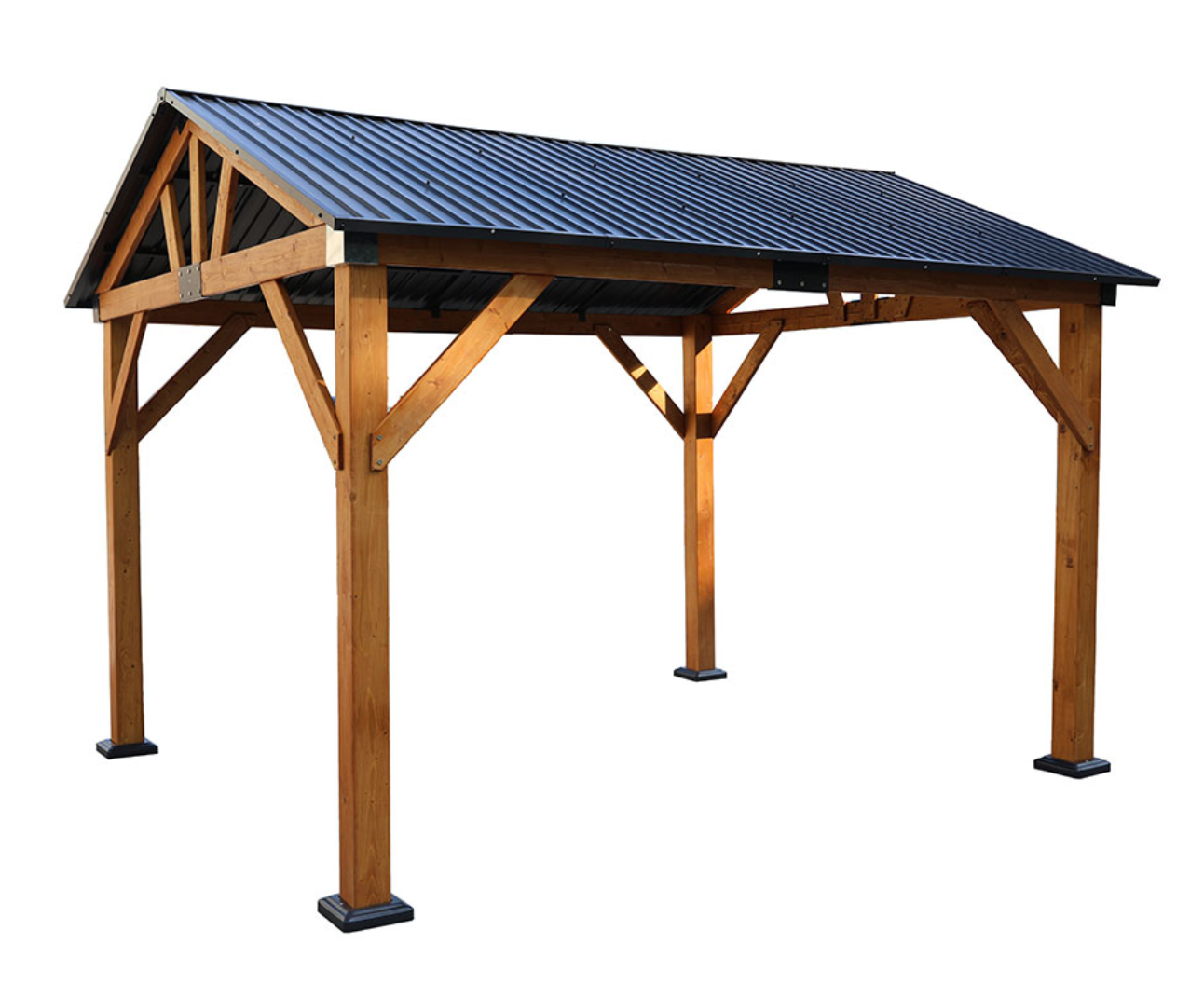
The hardtop gazebo with an aluminium frameis a good reference case, because in a hard-roof structure the frame surface and the Canopy interface matter as much as the fabric itself.
I have spent more than twenty years in outdoor structures — carports, awnings, gazebos, Inflatable Tents and greenhouses — and the question I get most from event rental companies, garden furniture distributors and municipal parks departments is simple: how long does the roof last. It is also the question that is most often answered with a number that cannot be defended.
What Actually Happens to a Canopy Fabric Under Sunlight
UV degradation in a polyester Canopy is a photochemical chain reaction, and it attacks the strength of the fabric rather than only its colour.That distinction is the whole argument, because a Canopy that has lost half its tensile strength looks perfectly acceptable right up until the first strong wind.
Photon-initiated chain scission
The mechanism works like this. Polyester is a PET polymer, and in the 290 to 400 nm wavelength range the polymer chains absorb photon energy. That absorption creates free radicals, the radicals break molecular bonds, and the chain continues: one broken bond leaves two new chain ends, and the process repeats.
Because the degradation is a chain reaction rather than a surface effect, the loss of strength is cumulative and accelerating, which is why a fabric can look fine at year two and fail at year three.
Why tears appear where they do
Tear propagation in a Canopy rarely starts in the middle of a panel. It starts at the highest-stress point: the seam, the corner, the valance edge, or the point where the fabric is clamped to the frame. A weakened fabric with a high stress concentration produces a tear that then runs, because the load has to go somewhere.
Because the tear is a mechanical event and not a chemical one, the visible symptom is a tear that starts at a fixing point and runs, which is exactly the failure that ends a rental contract or fails a municipal asset inspection.
Fading is the visible part; embrittlement is the dangerous part
Colour change is what a buyer notices first, and it is measured separately. Our published position is that colour fastness to artificial light is guaranteed to ISO 105-B02 at Grade 4 minimum, with Pantone-matched dyeing supported to a Delta E below 2.0 for custom colours from 100 pieces per size.
The Two Stabilizer Systems That Do the Work
UV resistance in a Canopy fabric is chemistry, and it comes from two complementary systems: radical scavengers that stop the chain reaction, and absorbers that soak up the damaging wavelengths before they reach the polymer.
Hindered amine light stabilizers
HALS are the radical scavengers. They intercept the free radicals that the photochemical process creates and neutralise them before they can break a bond, which is why they are effective at protecting mechanical strength rather than colour. Our published loading is 0.3 to 0.8% w/w.
UV absorbers
The benzotriazole class converts absorbed UV energy into harmless thermal energy before it can do damage. Our published loading is 0.2 to 0.5% w/w. Absorbers are what protect the surface and the colour; scavengers are what protect the bulk strength.
Because the two systems work on different parts of the failure chain, they are synergistic rather than interchangeable, and a Canopy specified with only one of them is exposed on the other axis.
Integrating with the fabric
Because a flame retardant treatment that destroyed the UV stabilizer performance would create a false choice between safety codes and service life, the correct question is whether the two have been tested together rather than whether one of them was sacrificed.
What to ask for
- The stabilizer type and loading, as a percentage by weight, not as a pass or fail against a rating.
- The base cloth construction — denier, weave, and whether it is 600D or 420D Oxford.
- Whether the flame retardant treatment, if any, has been tested together with the stabilizer system and to what criterion.
Our own published guidance on this point is blunt: beware of a supplier claiming a proprietary treatment without disclosing the composition, and beware of a fabric whose UV claim rests on a colour rating alone.
Coating, Denier and the Frame Interface
The coating is the barrier that keeps water out and the sun's heat in, and PU and PVC fail in completely different ways. Choosing between them on price or on feel is how a canopy gets specified for the wrong climate.
PU coating
A high-quality polyurethane coating offering a 1,500 to 3,000 mm hydrostatic head, combined with a UV-resistant topcoat, provides exceptional flexibility and weatherproofing. Flexibility is the operative word: a PU coating moves with the fabric under wind load and thermal cycling, which is why PU is the usual choice for pop-up and folding structures that are packed and reopened repeatedly.
PVC laminate
PVC laminates offer robust UV reflection and heat aging resistance, tested at 70 °C for 168 hours to ASTM D573, which makes them suitable for permanent installations where the structure will not be moved.
Because a PVC laminate that has passed heat aging and a PU coating that has lost its hydrostatic head fail for opposite reasons, the coating choice follows the deployment: a structure that gets packed and reopened needs PU, a permanent installation can take PVC.
Denier, and what it does and does not tell you
Because denier and UV stability are separate properties, a heavier fabric without the right chemistry performs worse than a lighter fabric with it, which is why the comparison has to be made like-for-like on the whole specification.
The frame, which is not a separate topic
Our hardtop gazebo is a clear illustration: 125 × 125 × 1.4 mm aluminium leg tube, 120 × 30 × 1.2 mm cross tube, 57 × 46 × 1.0 mm top tube, powder coated and painted, with a sloped roof and built-in drainage.
Validating the Claim: Accelerated Aging and Field Data
A warranty claim about canopy life is only as good as the test behind it, and the test is only meaningful when the protocol is stated. This is where most canopy claims in the market fall short.
The accelerated aging protocol
Our validation uses ASTM G154 UV accelerated aging protocols, with UVA-340 lamps at 0.89 W/m² at 340 nm on an 8-hour UV and 4-hour condensation cycle. That is the protocol behind our 1,000-hour warranty validation.
Because 1,000 hours of QUV means nothing without the lamp, the irradiance and the cycle, a supplier who quotes only the hour count has quoted the least informative part of the test.
What gets measured at each interval
Because a canopy replacement programme only helps if the replacement can actually be sourced years later, the parts availability commitment is as much a durability statement as the fabric specification.
The field figure, and why it is the honest answer
Field data from punishing Australian markets demonstrates that our 600D Oxford with UV-resistant PU coating maintains an annual tear-related failure rate of less than 3%, while standard 420D Oxford without UV coating suffers an 8 to 12% failure rate under identical conditions. We recommend the UV-stabilized fabric for markets experiencing more than 300 days of annual sunshine.
Because a failure rate in a named climate is something a buyer can plan around and a fixed lifespan is not, the rate is the more useful number even though it is the harder one to publish.
Compliance, because it constrains the formulation
Frequently Asked Questions
How many years does a canopy fabric actually last?
The honest answer is a rate in a named climate rather than a number of years, because the same fabric performs very differently across a Mediterranean summer and a Northern European one. Our published field data from high-UV Australian markets shows an annual tear-related failure rate below 3% for UV-stabilized 600D Oxford with a UV-resistant PU coating, against 8 to 12% for standard 420D Oxford without UV coating under identical conditions. We recommend the UV-stabilized fabric for markets experiencing more than 300 days of annual sunshine.
Why does my canopy tear rather than fade?
Because UV degradation in polyester is a photochemical chain reaction that breaks molecular bonds, not a surface effect that only changes colour. In the 290 to 400 nm band the polymer chains absorb photon energy, free radicals form, and the chain continues. Without mitigation, fabrics lose 30 to 50% of their tensile strength after just 1,000 hours of UV exposure, and tear propagation follows wherever there is a stress concentration. Colour fastness is measured separately and can be perfectly satisfactory while strength is already failing.
What does UV resistant actually mean on a fabric specification?
On its own it means very little. The useful specification names the two systems and their loadings: hindered amine light stabilizers at 0.3 to 0.8% w/w acting as radical scavengers, and benzotriazole-class UV absorbers at 0.2 to 0.5% w/w converting UV energy into harmless thermal energy. It should also name the base cloth and the coating, because the stabilizer system only delivers its published tear strength retention when integrated into a specified fabric construction.
Does a thicker fabric last longer in the sun?
Not on its own, and this is the most common specification error. Fabric weight governs handling, puncture resistance and how the cloth sits on the frame, but it is not a UV rating. Our 600D Oxford with UV-resistant PU coating holds an annual tear-related failure rate below 3% in high-UV markets, where standard 420D Oxford without UV coating fails at 8 to 12% under identical conditions. The difference is the chemistry and the coating, and the comparison only means something when the rest of the specification is held constant.
Which Approach Should You Take?
Specify the canopy against exposure and chemistry, validate the claim with a protocol and a field rate, and treat any fixed lifespan as a warranty term rather than a technical fact.
Because the degradation is a rate and not a threshold, the useful number is the failure rate in a climate like yours — and that is the number most suppliers will not publish.
Our photo-oxidative degradation mitigation guidance covers the mechanism and the mitigation in detail, and the commercial reality sits underneath it: a 2 to 5 year canopy warranty validated on QUV to ASTM G154 at 1,000 hours, custom colours from 100 pieces per size with Pantone matching to Delta E below 2.0, and a 5-year parts availability commitment covering replacement canopies, frame tubes, connectors and foot plates with orders shipping within 7 to 10 working days.
We have been manufacturing and exporting outdoor structures for more than twenty years, across carports, awnings, gazebos, inflatable tents and greenhouses, and we would rather quote you a failure rate in your climate than a lifespan we cannot defend. Because the buyer who asks for the protocol and the field rate has already told us the market we are building for.
Talk to Us About Your Market
For a direct project discussion, contact Alice at qh@nbqiahe.com or on WhatsApp +86 18892661949, with the factory on +86 13567931228 at No.1288, Tanjialing West Road, Lanjiang Street, Yuyao City, Zhejiang Province, China. Send the intended market and its annual sunshine hours, the structure type and whether it is permanent or redeployed, the required fire standard and the quantity, and you will get a fabric specification with the stabilizer loadings, coating and aging protocol written against your climate rather than a generic lifespan claim. You can also reach us through the contact page.