




Ask any awning manufacturer for the wind behaviour of a commercial awning and most will show you a fabric weight, a tube diameter and a warranty, which is the answer I usually get. That is a specification for the product. It is not a specification for the thing that actually protects it — the night somebody extends a sail over a shop front and then goes to bed.
TL;DR
- A commercial awning needs a wind input, a defined retract sequence and a fail-safe that retracts, and the published specification sheet is very often where all three are missing.
- The manual 1.5 m handcrank model has no wind protection at all, because retracting it depends on a person making the decision, and the people who extend an awning in the evening are not the people who are awake at 2 a.m.
- The frame dimensions decide the wind design: arm projection sets the sail area, the 47 × 35 × 1.0 mm front tube is the leading edge that takes the highest load, and the two wall brackets are where the whole reaction has to end up in the wall.
- Auto-retract is a sequence, not a switch: sense, decide, drive the motor to a defined position, confirm with the limit switch, latch, and retract on sensor fault rather than stay put.
- Before the purchase order, ask for five documents: the wiring diagram, the threshold and hysteresis table, the sensor data sheet, the fail-safe sequence written out as steps, and the sensor mounting instructions. No five documents, no specified package.
A wind sensor and an auto-retract system on a commercial awning are not an accessory, they are the difference between a shade product and a structure somebody can defend. I work with buyers who specify awnings for cafés, boutiques and retail frontage, and the single most common gap in their specification, in my experience, is not the fabric or the motor. It is that nobody has written down what the awning does when the wind gets up. Because the published specification for a commercial awning is overwhelmingly a list of dimensions and a list of finishes, and because a wind event is the failure mode that turns a retail awning into an insurance claim, I would put the wind and retract specification in the same category of importance as the frame itself.
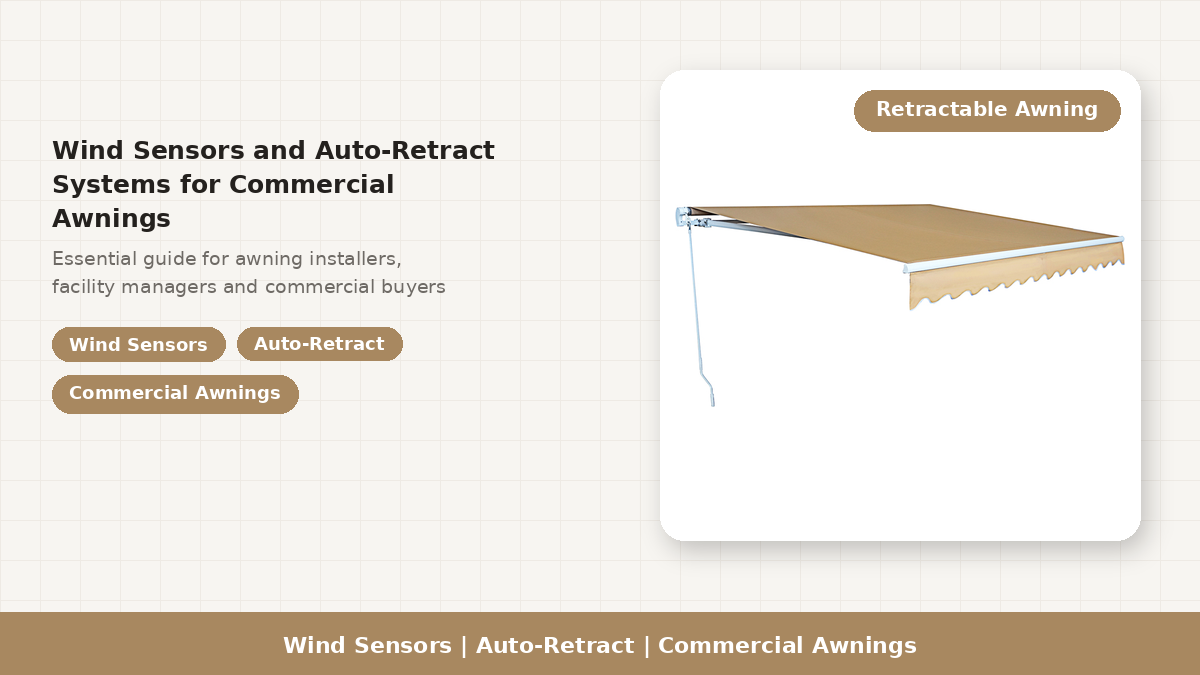
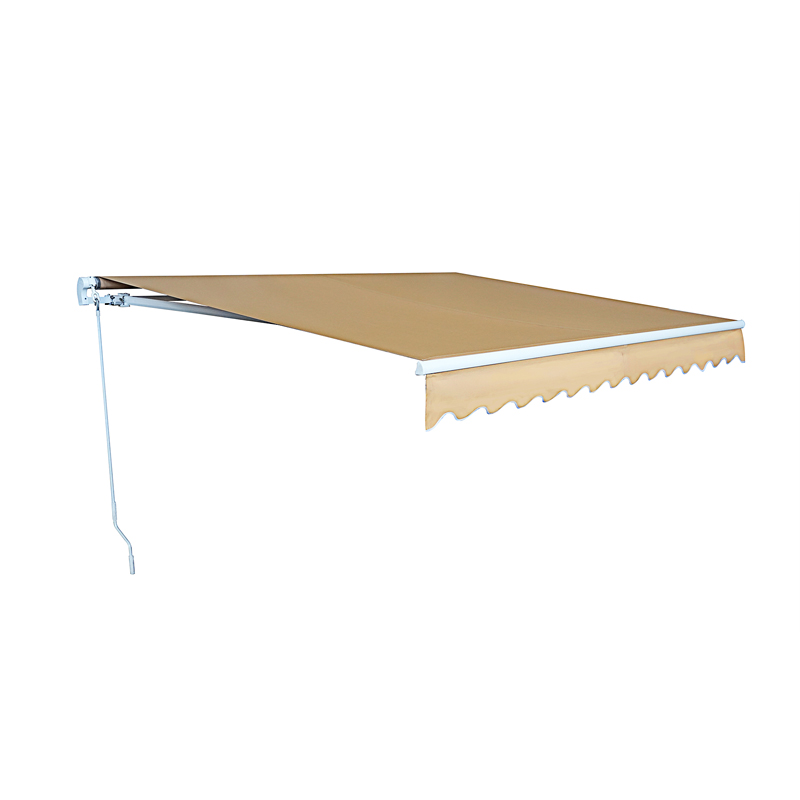
There is a piece of honesty I owe the reader before we go further, and it is about our own published sheet. The QIAHE awning is supplied in manual and electric versions on a fully specified aluminium frame, and the published specification runs to nine numbered lines — beam, roller, brackets, arms, front tube, fabric, handcrank — and then stops. There is no wind sensor line, no rain sensor line, no controller line and no retract behaviour line, and the product attribute table on the page is empty. That is not an accusation, it is how many awning spec sheets are written, and it is exactly why a buyer has to ask for the wind package explicitly instead of assuming it is included.
Why a Manual Awning and an Auto-Retract Awning Are Different Products
The manual and the electric version of the same awning are not the same product with a nicer handle, because only one of them has a defined behaviour when the wind arrives. Our published awning is offered in both, and the manual version is operated by a 1.5 m handcrank, which is a deliberate choice I defend often: it needs no motor, no controller, no power supply and no commissioning, and it is the version that goes into balconies, backyards and light commercial frontage where somebody is present.
The manual version has a simple and, in a commercial context, uncomfortable property, and it is the one I raise with every commercial buyer: retracting it depends on a person deciding to retract it. Because the fabric is extended by somebody who has just finished work for the day, and because the weather does not keep office hours, the decision to retract becomes a decision that has to be taken by a person who may not be there. I do not think that is a fair way to run a 280 g PU-coated sail over a shop front on a coastal street.
The auto-retract version changes the mechanism of that decision rather than the risk, and I would argue it changes the risk as well. The sensor takes the decision, the controller acts on it, and the motor does the work at 2 a.m. Because the wind is the structural risk rather than the comfort risk, the thing that has to be specified is not a comfort feature, it is a load case, and that is why I would not accept it as an option line on a quotation.
Two things follow from that, and they are the practical content of the rest of this article, which is how I would use it in a specification meeting. The first is that the wind package has to be written into the specification with the same seriousness as the frame. The second is that the frame dimensions on the published sheet are the inputs the wind design runs on, which is where I go next.
What the Published Frame and Fabric Numbers Mean to a Wind Engineer
Every dimension on an awning specification sheet is a wind design input, and the reason the published list stops at the fabric, in my view, is that the sheet was written for a buyer, not for the person who has to decide when the thing folds up. Here is how I read the published QIAHE specification, line by line, when the question is wind.
| Published specification | Value | What it means for the wind and auto-retract design |
|---|---|---|
| Square beam | 35 × 35 × 1.5 mm aluminium | The spine of the cantilever. Its section sets the bending stiffness the whole projection depends on, and it is where the motor torque reaction is taken. |
| Galvanised roller | 70 mm diameter, 1.0 mm wall | Sets the retracted drum diameter, which is the size of the package that has to clear the bracket on the wall and the soffit above it. |
| Aluminium wall brackets | 2 brackets | The end of the load path. Whatever the sensor does, the wind reaction still finishes in these two brackets and in the wall behind them. |
| Aluminium big arm | 50 × 27 × 1.0 mm | The primary member carrying the sail. Its projection, combined with the fabric width, is what defines the sail area the wind actually pushes on. |
| Aluminium small arm | 44 × 22 × 1.0 mm | The outrigger. It sets the maximum cantilever and therefore the moment the big arm and the bracket see in the worst gust. |
| Front tube | 47 × 35 × 1.0 mm | The leading edge. It takes the highest local load, it is where the fabric is tensioned hardest, and in a storm it is also the first thing to strike something. |
| Fabric | 280 g sunscreen polyester with PU coating | The sail itself, and the part whose life the wind design sets. The coating gives water repellency and UV resistance, but the fabric degrades from the load and the UV, not from the rain. |
| Handcrank | 1.5 m | The manual override. Its existence is why a system that can be overridden still has a place in a specification. |
| Wind sensor and retract behaviour | Not published on the product page | The gap, and the reason the rest of this article exists. It has to be specified by the buyer rather than assumed. |
Because the roller diameter sets the retracted package size, the auto-retract design has an installation constraint that the sensor specification does not appear in, and I would put it on the drawing: the retracted awning still has to fit where it is going to live. A wind design that retracts the awning into a position that fouls a soffit, a fascia or a signage bracket is a wind design that fails at the moment it is needed. The bracket spacing, the roller diameter and the retracted length are one conversation, and they are a conversation between the installer and the fabricator rather than between the sensor supplier and anybody else, which is why I would not send it out with the electronics package.
One more published number deserves a line of its own, because it is the one that ages worst. Because a 280 g PU-coated sunscreen polyester loses strength from UV and from repeated flexing at the roller, the wind design and the fabric life are the same number viewed from two ends, and neither of them can be extended by buying a heavier gauge of anything, which I have seen buyers try. The way to extend the life is fewer wind events, which means a better sensor and a better threshold, which brings us back to where the money is, and I would not pretend otherwise.
The Four Inputs a Commercial Awning Controller Should Have
Four inputs, and the one everybody forgets is the one that matters most commercially, in my experience. I would not accept an awning controller with fewer, and I would want all four written down with their trigger behaviour.
| Input | What it protects against | What it must do when it triggers | The failure to design for |
|---|---|---|---|
| Wind sensor | Structural overload of the extended fabric, the arms and the brackets. | Drive the motor to the retracted position, confirm with the limit switch and latch. | Retracting in a gust so hard that the fabric or the roller is damaged by the retraction itself. |
| Rain sensor | Water reaching the customer, the merchandise and the fabric. | Retract and hold, and stay retracted until the moisture clears and the timer permits. | Hunting, where the sensor cycles the awning in and out on a damp evening. |
| Timer and light sensor | An awning running at 3 a.m., or a motor drawing power through the night. | Hold the awning retracted outside the permitted window, without fighting the wind input. | A timer that re-extends the awning in the wind because the two inputs are not interlocked. |
| Limit switches and manual override | A motor running into a hard stop, and a system nobody can service. | Confirm position to the controller and let an operator override the sensor logic. | A safety system with no manual path, which guarantees a service call rather than a repair. |
Because the timer and the wind sensor are two different authorities on the same awning, the specification has to say which one wins, and I make that the first line of every specification I issue. If a timer reaches its extension window in the middle of a gust and the wind input is advisory rather than dominant, the awning goes out into the weather it was just brought in from. In every design I have specified, wind is the dominant input, the timer only requests, and the timer request is refused while the wind input is active.
How Auto-Retract Actually Works: The Sequence and Its Fail-Safe
Auto-retract is a sequence with a defined end state, and getting that end state wrong is the most common way I have seen a wind package fail on site. The sequence we write into an OEM specification runs like this.
- Sense. The wind sensor reports a speed, and on a combined sensor a direction as well. Direction matters, because a crosswind on an extended awning is a different load case from a headwind, and a sensor that only reports speed will retract for the wrong reason and get ignored by the operator, which I have seen in the field.
- Decide. The controller compares the reading against the threshold, and it does so with a hysteresis band and a time delay, so a single gust does not trigger a retraction and the awning does not hunt around the set point, which is the failure I would design out first.
- Drive. The motor runs the awning in, and the fabric is guided onto the roller while the arms are still carrying it. This is why a retract command cannot simply be a motor stop, and it is the detail I see missing most often in a specification.
- Confirm. The end-of-travel limit switch reports that the arms and the roller have reached the retracted position, and only then does the controller latch, which is what makes the sequence auditable.
- Stay retracted. The awning holds in the safe position until the wind drops below the release threshold, the time delay has elapsed and the timer permits extension, and I would write all three conditions into the handover document.
The fail-safe is the part that gets skipped, and it is the part I would insist on in writing. Because the safe state of an extended awning in unknown wind is retracted, a sensor fault, a wiring fault or a controller fault has to drive the awning to that safe state rather than leave it where it is. The common alternative, which is to ignore the fault and hold the last position, is a design that assumes the last position was safe, and in a gust sequence the last position was extended, which is the wrong assumption to build on.
And then there is the override, which is not optional, and I would not accept a design without it. Because a technician standing on a ladder with a fault code needs to be able to extend or retract the awning regardless of what the sensor believes, the manual path has to survive every fault condition in the system. A system that cannot be overridden is a system that cannot be serviced, and for a retailer that means a callout instead of a five-minute fix.
How to Specify a Wind Sensor and Auto-Retract Package
This is the sequence I would run for an OEM or ODM programme, and it is deliberately ordered so that the expensive decisions come first.
- Define the exposure. Installation height, the direction the frontage faces, the distance to the nearest obstruction, and whether the site is exposed, semi-exposed or sheltered. The exposure classification is what turns a wind threshold from a guess into an engineering value, and it is the input most often missing, in my view.
- Choose the sensor technology and the mounting position.A cup anemometer measures speed, a reed or Hall switch with a magnet measures direction, and a solid-state sensor has no moving parts to seize. Wherever it goes, it has to sit in the free stream above the Canopy edge rather than inside the building’s own turbulence, because a sensor in a recirculating pocket reads the wrong wind and gets the awning retracted for no reason, which I would expect to see on a sheltered street.
- Set the threshold, the hysteresis and the time delays together. I specify all three as a set and never one of them on its own. A wind threshold that retracts, a lower release threshold that re-extends, and a delay on both, so the awning acts on a sustained condition.
- Define the retract position, not just the command. For a retractable awning the safe position is a defined geometry, because the fabric has to be guided onto the roller while the arms are still loaded, and the retracted package has to clear the bracket and the soffit, which I confirm on the installation drawing.
- Design the fail-safe and the manual override together. Sensor fault to safe state, and an operator path that works with the sensor active, which I would test on site before the container leaves.
- Specify the power, the interface and the motor limits. Mains, solar with a battery, or low voltage, and the motor’s own current limit, thermal protection and end-of-travel switches. The current limit is worth naming, because a blocked or stalled motor is a measurable event that a controller can treat as a trip, and I would use it as a secondary wind indication.
- Demand the five documents with the quotation. Wiring diagram, threshold and hysteresis table, sensor data sheet with its environmental rating, the fail-safe sequence written out as steps, and the sensor mounting instructions. If a supplier cannot produce them, I treat the package as a promise rather than a product.
Where the standards sit, and where they do not
For a fixed awning there is no directly applicable product standard, which is precisely why the behaviour has to be written into the product documentation. The nearest harmonised reference for outdoor shade structures is the European outdoor furniture series, where EN 581-2 sets safety requirements for sunshades and parasols and EN 581-1 defines the terminology. The wind loading itself comes from the structural side: Eurocode 1 and its wind actions cover the design wind for a location, and the ASCE 7 standard is the US equivalent. A fixed awning can be engineered against those, and then the sensor threshold is set below the design wind action of the installed structure, because the sensor is a trigger and not a calculation.
Where a Wind Sensor Is the Wrong Specification
There are five cases where specifying a wind sensor package is the wrong call, and I would rather name them than take the specification.
- The awning is retracted every night by the timer anyway, because a permanently extended commercial awning is unusual and the exposure window is short, which I would confirm with the operator first.
- The installation is in a sheltered courtyard or under a permanent overhang, where the exposure classification is sheltered and the added electronics are cost without benefit.
- The awning is a display or promotional item rather than a shade structure, and it is not left extended overnight, in which case the manual version is entirely adequate.
- The frontage is in a market with no service capability within a reasonable distance, because an automatic system that cannot be serviced is worse than a manual one that always works, since a failed auto-retract leaves the awning stuck part way, and I have seen that happen.
- The buyer has not decided the operating policy, because a sensor that retracts on a threshold nobody has agreed with the staff will be overridden by the staff, and an overridden sensor is an expensive ornament.
One last piece of honesty about the numbers in this article. The dimensions, materials and finishes quoted here are our own published specification, accurate as of the verification date below, and the engineering commentary is our interpretation of that specification for a wind and auto-retract design. Neither is a site-specific wind calculation, and neither substitutes for the local design wind action of the installation, the mounting detail into the wall, or the instructions of the awning’s own supplier. The value of this article is that it tells you what to ask for, and that is a different and more achievable thing than telling you the answer, which I could not do for your building.
Frequently Asked Questions About Awning Wind Sensors and Auto-Retract
Do commercial awnings need a wind sensor?
Any awning that is extended overnight or left out in an exposed position needs one, and the argument is not really about comfort, in my experience. A 280 g PU-coated fabric on a cantilevered aluminium frame behaves as a sail when it is extended, and the manual handcrank version relies on somebody deciding to pull it in. A sensor moves that decision from a person who may be asleep to a controller that is not.
What happens when the wind sensor trips?
The controller drives the motor to the retracted position, the arm and roller reach their end-of-travel limit, the limit switch confirms the position and the controller latches. A well-designed sequence does not merely stop the awning where it is, because a half-retracted awning under load is the worst state to be in, which is the state I would design out first, and the fabric has to be guided onto the roller while the arms are still carrying it.
What happens if the sensor itself fails?
The safe state is retracted, so a sensor fault has to drive the motor to the safe position rather than leave the awning extended on a reading nobody can trust, and I would not sign off a design that does anything else. A manual override has to remain available so a technician can work on the awning even with the sensor active, because a system that cannot be overridden becomes a system that cannot be serviced, which I see in the field every year.
Is a rain sensor enough for a commercial awning?
No, because rain and wind are different risks, and I would ask for both on a commercial awning. A rain sensor protects the fabric and the customer from water, and it is comparatively easy to specify. Wind is the structural risk: it is the load the extended fabric puts into the arms, the roller and the wall brackets, and it is the one that damages the product and the installation. A commercial awning controller should have both, and the wind input is the one most often left out.
How is the wind threshold chosen for a commercial site?
From the exposure of the site and the design wind action for the location, not from a rule of thumb. The Eurocode 1 wind actions framework and its JRC implementation resources give the site design wind speed, and the US equivalent is the ASCE 7 standard. The threshold the controller uses then has to sit below the design wind action of the installed awning, because the sensor is a trigger and not a structural calculation.
Does the awning frame size change the wind design?
It changes everything, because the frame defines the sail. The published QIAHE awning uses a 35 × 35 × 1.5 mm aluminium square beam, a 70 mm diameter galvanised roller with a 1.0 mm wall, an aluminium big arm at 50 × 27 × 1.0 mm, a small arm at 44 × 22 × 1.0 mm, a 47 × 35 × 1.0 mm front tube and two aluminium wall brackets. The arm projection sets the sail area, the front tube is the leading edge that takes the highest load, and the wall brackets are where the whole reaction has to end up in the wall.
Are sunshades and parasols covered by the same safety standards as awnings?
The closest harmonised reference is the European outdoor furniture series, where EN 581-2 sets safety requirements for sunshades and parasols and EN 581-1 defines the terminology. A fixed awning sits outside that scope, which is exactly why specifying the wind behaviour in the product documentation is the buyer’s only route to a defensible installation, and I would say so to anyone who asks for a certificate for a fixed awning.
What should an OEM buyer ask for so the sensor package is not a surprise?
Five documents before the purchase order: the wiring diagram, the threshold and hysteresis table, the sensor data sheet with its environmental rating, the fail-safe sequence written out as steps, and the installation instructions for the sensor position. If the specification sheet you are given stops at the fabric and the handcrank, as many published awning sheets do, then the sensor package is not specified and you have to specify it yourself, which is the whole point of this article.
Send us your frontage, your exposure and your awning size, and we will specify the wind package
Share the installation height, the direction the frontage faces, the awning size and the operating window you need, and we will come back with the wind and rain input definition, the retract sequence and the fail-safe behaviour, the document list to put on your purchase order, and an honest answer on whether the manual version is adequate for your site. Start with the OEM and ODM manual and electric aluminium awning specification and the retractable canopy range, or talk it through on the contact page.