






Searching to winterize carport fabric snow setups is usually how people arrive here, and the answer is that it is not one job. It is three jobs that happen on different schedules, and the reason most winter damage looks sudden is that the failure was built up months earlier.
A fabric carport has no shell to shed water. Its cover is a tensioned membrane, and a membrane works by staying taut. Snow does not just add weight to a fabric carport — it changes how that fabric sits. Slack fabric catches snow at the low point instead of sliding off it. So the cover that survived October can be the reason the frame buckles in January, and the snow is only the last twenty minutes of the story.
Everything below is about the operating season: what to do, when, and what each check actually tells you.
What actually breaks first, and why
The instinct is to assume the frame carries the snow. On a fabric carport the frame is usually the last thing to complain and the cover is usually the first.
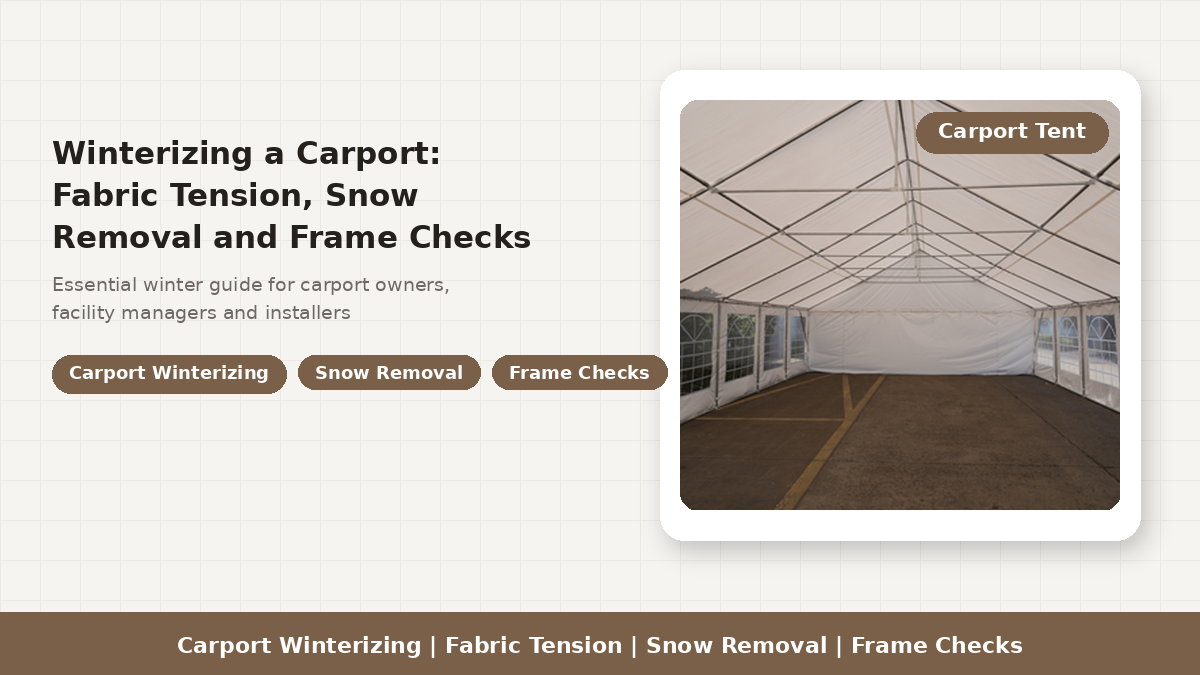
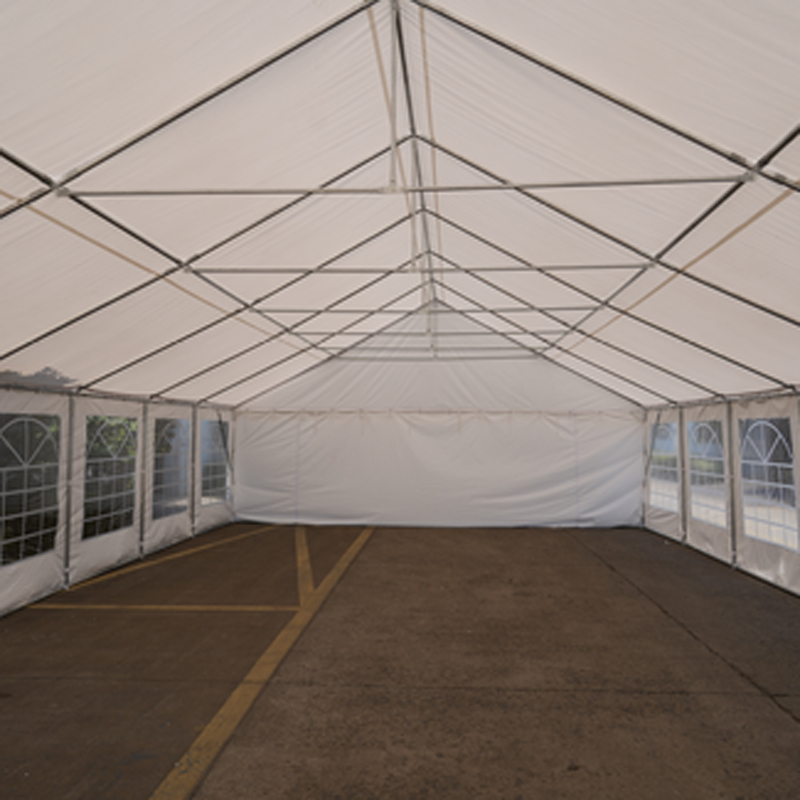
Consider our heavy-duty PVC outdoor event storage canopy carport. The cover is a knife-coated PVC fabric with the frame carrying its weight continuously, and the fabric is tensioned across the rafters rather than draped over them. That distinction decides your winter. A draped cover sags between rafters, forms a series of shallow valleys, and each valley is a place where snow can sit. A tensioned cover spans the rafters, so its lowest point is the low point of the structure itself.
Now the sequence that matters. Snow loads up. The cover's slack increases because the frame deflects slightly under load — and a membrane cannot develop tension in a surface that has sagged out of plane. At that point the two jobs swap: instead of the cover distributing load into the frame, the frame starts carrying the shape of whatever the snow has done to the cover. A small deflection that was harmless in October becomes the shape that collects more snow, and the collection rate beats the shedding rate. That is the feedback loop, and it is why the collapse, if it comes, arrives suddenly.
There is a second failure mode with the opposite cause. If tension is high but the fabric has gone slack for another reason — a stretched panel, a loosened rafter connection, a cover that has taken a set — the membrane can go from taut to drum-tight, and then loads concentrate at the corner fittings rather than spreading. Fabric is strong and it is not stiff. Strength does not substitute for geometry.
Both modes have the same remedy, and it is not a heavier frame.
The three checks, in the order the season actually runs
Tension first, in autumn. Walk the length of each panel and look at it side-on. Slack reads as a visible sag, a panel that holds a shallow bowl after rain, or a corner that no longer sits flat against its fitting. This is the single most valuable ten minutes of the year and it is the only one of the three checks that is entirely under your control.
Clear before it settles, not after. Snow removal that happens at 10 cm is routine. Snow removal that happens at 60 cm involves a ladder, a roof surface, and a person standing on a structure that was already at the limit. Plan the trigger by depth, not by when you happen to notice.
Frame last, before the season, not during it. This is the check most owners put first because it is the most visible, and it is the least informative. The frame is what tells you the outcome. Cover tension tells you the cause.
Snow removal: work out your own trigger number
The useful question is not "how much snow is too much." It is "at what depth does this structure stop being the thing I bought."
For context on what these structures are actually specified for, QIAHE's snow collapse article sets out the load bands the product line is built around: a residential configuration at 1.5 m frame spacing and a shallow pitch sits in roughly the 30–50 kg/m² range, while a heavy-duty commercial configuration at 1.0 m frame spacing and a steeper pitch is specified around 100–150 kg/m². Our carport snow collapse prevention piece works through the frame spacing and pitch math behind those numbers.
Two conversions matter more than the number itself. First, snow load is not the depth you see. Fresh snow is light; wet, settled snow is the load that matters, and the same depth of settled snow can be several times the weight of fresh powder. So a fixed depth trigger is a poor proxy — the same 30 cm means very different things in December and in March. Second, the useful discipline is to clear in layers. Removing 10 cm at a time keeps the load moving and keeps you working from the lower edge upward, where you can see what you are doing.
There is a method question too, and it matters for coated fabric. Dragging a steel shovel across PVC or PE coating is a good way to abrade the outer surface, and the damage shows up as chalking and then a leak a season or two later. A plastic blade, or a roof rake, keeps the contact face off the coating. On a small structure the slowest method is often the right one, because the alternative is spending a day on a ladder with a tool that damages what you are protecting.
On a pitched structure, gravity is doing part of the work for you — but only if the pitch is steep enough and the surface is clean enough that wet snow can actually release. Our awning fabric replacement cycles article covers the service-life side of coated fabric, which is a separate question from whether it survived this winter intact.
Fabric tension: the check everyone skips
This is the check that gets deferred, and the reason it gets deferred is that a sagging cover still keeps the rain off. It does. It just does it while quietly working against you.
Fabric tension should be restored before the first snow, not during it. Re-tensioning under load is not tensioning — you are chasing a moving target and you will set the panel where it is that afternoon rather than where it belongs.
The physical basis is worth stating plainly, because it explains why this beats adding structure. A tensioned membrane develops stiffness from geometry rather than from thickness or material mass. That is why adding a purlin or upgrading the tube does not fix a slack cover, while taking up tension does. A cover that is slightly slack over a wide panel has almost no effective stiffness, because the load path has to go where the fabric happens to be rather than where the frame is designed to take it. Take up the slack and the same fabric, in the same frame, develops the stiffness the frame was designed to exploit.
The practical version: tension is even from corner to corner, panels sit flat against the rafters rather than bowing between them, and fittings are engaged without the fabric being drum-tight at the corners. If you cannot bring a panel back to flat without overtightening, the cover has stretched. That is a replacement question, not a tensioning question, and the answer is not to compensate with more tension elsewhere on the same cover.
One caution specific to cold weather. Fabric and hardware both contract in cold conditions, so a panel that is correctly tensioned in September will read as tighter in January. Do not respond by adding tension in midwinter. Retensioning cold panels means storing tension that will be released when the material warms, and the common result is a cover that goes slack in spring in the one season when you most want it flat.
Frame checks: bolts, bases and the honest wear test
The frame check is worth doing, but it is worth doing for what it reveals rather than for what it can tell you about snow capacity.
Connections are the place to look. Our article on why pop-up canopy frames fail under cyclic wind loading covers why joints rather than tubes are the recurring failure location — the tube carries load, the joint carries the repetition. On a fixed carport the equivalent seasonal check is whether the fittings have backed off and whether the reinforcement is still where it was. If the frame has hardware at all, it is worth confirming the spec against something like EN 13561 wind classes before you assume a generic structure and a specified one are the same purchase.
Base and anchoring condition is the second thing. Freeze-thaw is the mechanism that matters in a cold climate, and it works on the ground rather than on the structure: water in the soil around a base freezes, expands, and moves the base. Our anchoring comparison for fabric carports covers how ground anchors, concrete bolts and ballast behave differently once the substrate is involved. What matters for winterizing is the visible version of it: a base that has moved, a leg that has gone out of plumb, a leg that rocks when you push it. A structure that has shifted its load path is no longer the structure the load rating was calculated for.
Surface condition is the third, and it is the one that connects to winter specifically. Salt and grit are what turns a cold-climate winter into a corrosion problem, and our rust timeline comparison for coated versus galvanized steel frames covers the material side. On a hot-dip galvanized frame the practical winter check is whether the galvanizing is still intact at the ground line and at fittings, where coating damage shows up first. A carport's frame spends the winter at exactly the height where road spray lands.
Leave it up or take it down: the decision people defer
This is the question that gets postponed until a forecast turns serious, which is exactly the moment to be deciding it.
Leave the cover on when the structure is rated for the local snow load and the cover is sound. These structures are built to be up in winter. A frame in its rated configuration with a cover in good condition is doing what it was designed to do, and stripping the cover off an otherwise sound carport to protect the cover is a trade that usually loses — you expose the frame to ice, wind and falling debris, and you have removed the structure's thermal and weather protection for nothing.
Take it down when the configuration is outside its rating. If the carport was set up with wider frame spacing or a shallower pitch than the local load requires, then no amount of care changes the arithmetic. This is the case where winterising genuinely does mean dismantling, and the decision is not about the forecast but about the specification.
Take it down when the cover has already degraded. A cover with a split seam, a torn panel or widespread chalking is not a membrane any more; it is a membrane with holes in it, and its ability to shed snow is compromised along with its ability to keep water out.
Take it down where drifting is expected. A carport in a valley, beside a bank, or next to a road that gets ploughed has a different snow profile from one in an open plot. Drifting is not the same as falling snow, and it puts load where the roof pitch never intended load to go — against a wall, in a leeward corner, at ground level against the base.
The fourth case is the one that catches experienced operators: a carport that has already been modified. Extra purlins added for storage, an extra roof section bolted on, a side wall fitted, a rack hung from the frame. Each of those is fine individually and changes the load path in ways the original rating never contemplated. When someone asks us whether a structure needs winterising, the first question we ask is not about the snow forecast — it is what has been added to it since it went up.
If you are not sure which case you are in, the honest answer is that you need the rating for the configuration in front of you, not for the product family. Our carport series covers the size and material range, and for a specific deployment site we can return a snow engineering report with the frame spacing, pitch and anchor specification — request one from our team rather than extrapolating from a catalogue figure.
Cold-weather material behaviour, and the limit of what a cover can do
Winter failure is not only a structural question. Coated fabrics change behaviour in the cold, and our lab notebook on cold-crack resistance in PVC and TPU covers this with measured data across four temperatures.
The mechanism is the glass transition. A PVC compound formulated for flexibility uses a plasticizer that stays mobile at low temperature; as the temperature falls, molecular mobility drops, the material stiffens, and eventually it can crack where it is folded or creased rather than where it is pulled flat. So a cover that is stored or folded badly can develop a crack in the cold that has nothing to do with the snow load on it.
Two practical consequences. Storage is a winterization task in its own right — a cover stored folded tight in a cold shed is being stored in the worst condition it will ever see, and slack storage (loosely rolled, off the ground, not creased) removes a failure mode that has nothing to do with how well the carport is engineered. And if you use a cover for winter storage under a carport, you are adding a load the frame was rated for without that load, in the coldest part of the year, while the fabric above it is at its least tolerant.
That last point deserves emphasis because it is a common and expensive habit. A carport roof is specified to carry snow, which is a light, evenly distributed, temporary load. Stacked furniture, tools, a stored vehicle or boxed inventory is a concentrated permanent load, and it usually weighs more than the snow that the frame was rated for. Concentrated loads also bypass the load path the frame was designed around.
What this means for OEM buyers and retailers
If you are specifying these structures rather than maintaining one, the seasonal frame above has a direct specification consequence.
Put the tension maintenance method in the manual. If the cover cannot be re-tensioned by whoever owns it, the maintenance cycle does not exist in practice and the whole operating-season argument collapses. Tensioning that requires specialist tools or disassembly converts a five-minute autumn job into a paid service call, and it will not happen.
Specify the removal trigger rather than the roof rating alone. A roof rating without a removal trigger is not an operating instruction, because the person on site does not know which of the two numbers applies to what they are looking at. Publishing a depth trigger — and a rule for what happens at that depth — is more useful than publishing a higher rating nobody can act on.
Be precise about which structure the rating belongs to. Ratings are specific to frame spacing, pitch, material and configuration, and the hardtop gazebo snow load features German retailers prioritise piece makes the opposite point in the hardtop category, where snow load certification is only one of four variables, where panel gauge, frame profile and pitch each move the number independently. A rating attached to a product family rather than to a configuration is not transferable, and winterizing decisions made from it are guesses.
Standards worth keeping on your desk when you specify: ASCE, ASTM International, EN standards, NFPA, SGS, TUV. For local climate data, NOAA and the US National Weather Service publish the historical snowfall figures that belong in your removal-trigger decision.
For pricing on your specific configuration, or a snow engineering report for your deployment site, get in touch with our team and we will size it properly.